




 4505
4505
In any modern laboratory — whether academic, industrial, clinical or research-based — precision, consistency and efficiency in liquid handling are essential. From routine titration to complex reagent preparation, selecting the right liquid dispensers and laboratory dispensing equipment will significantly impact data quality, workflow efficiency and user comfort. Among the most common choices are manual liquid dispensers and automated liquid dispensers. Each class of instrument has its place, advantages and limitations. Understanding these differences helps laboratories make informed decisions tailored to their needs.
Understanding Manual Liquid Dispensers
Traditional manual dispensers, including manual bottle-top dispensers, have been the backbone of laboratory liquid dispensers for decades. These tools rely on a piston or plunger mechanism operated by hand. By pulling and pressing a plunger while controlling volume with a dial or knob, the user draws liquid from a reservoir and dispenses it into the receiving vessel. The volumes are typically adjustable within a specific range, offering repeatable results when operated correctly. Manual systems are common in general laboratories, educational settings, field labs, and situations where simplicity is paramount.
Advantages of Manual Liquid Dispensers
- Simplicity – With no electronics or motors, manual liquid dispensers are straightforward to use and maintain. There’s no training required beyond basic operation.
- Cost-Effective – Manual options generally have a lower purchase cost; they are ideal for laboratories on tight budgets or for occasional use.
- Durable & Portable – With fewer moving parts and no electrical components, they are robust and suitable for field or remote applications.
Limitations of Manual Dispensers
- Manual systems are user-dependent, which means precision and repeatability can vary with technique and operator fatigue.
- They are less ideal for repetitive, high-throughput tasks, as extended manual use increases the likelihood of inconsistency and strain.
In many basic lab workflows — routine reagent transfer, occasional dilutions, and general solution handling — manual dispensers fulfill needs competently and efficiently.
What Are Automated Liquid Dispensers?
Automated liquid dispensers represent the next evolution in laboratory liquid dispensers, incorporating motorized pistons, digital interfaces, and programmable controls to automate the aspiration and delivery of liquids. These devices are especially important in highly controlled, high-throughput, or precision-sensitive environments such as pharmaceutical labs, clinical diagnostics, and analytical chemistry workflows.
Advantages of Automated Liquid Dispensers
- Precision & Accuracy – With digital control of piston movement and volume settings, automated systems deliver consistent and highly accurate results, minimizing human error.
- High Throughput Efficiency – Programmable modes allow automated delivery of repeated volumes, saving time and reducing operator fatigue for large workflows.
- Enhanced Features – Many electronic dispensers include data memory, volume presets, multi-dispense modes, and even integration with laboratory information management systems (LIMS).
- Ergonomics & Comfort – Automation reduces repetitive strain and improves user comfort — a significant factor in high-volume labs.
Limitations of Automated Dispensers
- Higher upfront costs and occasional maintenance of electronic components make automated units a bigger investment.
- Training may be required to operate advanced features effectively.
Both manual and automated dispensers have their place. For laboratories where precision, speed, and reproducibility matter most, automated systems offer compelling long-term value. Meanwhile, manual tools remain valuable where simplicity, durability, and cost effectiveness are priorities.
Manual vs Automated: Direct Comparison
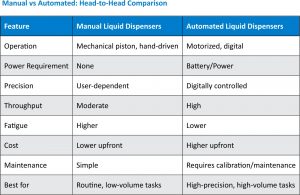
This side-by-side comparison highlights that while manual dispensers are simple and cost-effective, they lack automation and the reproducibility offered by electronic solutions.
Microlit Bottle Top Dispensers – Manual Liquid Dispensers with Outstanding USPs
In the realm of laboratory dispensing equipment, bottle top dispensers remain one of the most important categories of manual liquid dispensers. Designed to mount directly onto reagent bottles and dispense accurate volumes safely and conveniently, Microlit® Bottle Top Dispensers represent some of the most versatile and reliable manual tools available.
All Microlit Bottle Top Dispenser variants benefit from patented innovations such as EasyKnob® and FlexiNozzle®, which improve usability, flexibility, and comfort — regardless of the specific model chosen.
Microlit SCITUS Bottle Top Dispenser
The Microlit SCITUS is engineered for high precision and chemical compatibility in general laboratory tasks. It features SpringlessValve® technology for smooth, jam-free operation and supports a broad range of reagents and solvents. Its PTFE piston and easy-to-adjust volume knob make it ideal for daily dispensing needs with excellent reliability and ergonomics.
Microlit BEATUS Bottle Top Dispenser
The Microlit BEATUS expands on SCITUS with Recirculation Valve technology. This design prevents reagent loss during priming and ensures bubble-free dispensing — a crucial advantage when handling expensive or limited-volume solutions. It also comes with adjustable nozzle and ergonomic features that enhance user control and comfort.
Microlit LENTUS® Bottle Top Dispenser
For harsh chemicals and highly corrosive acids like Hydrofluoric acid, the Microlit LENTUS® model stands out. Designed with advanced materials and robust SpringlessValve® technology, LENTUS® offers top-tier chemical compatibility and safety. It combines precise control with additional operational flexibility, making it suitable for demanding laboratory environments where reagent safety and performance are non-negotiable.
Microlit ULTIMUS Bottle Top Dispenser
The Microlit ULTIMUS represents the most sophisticated offering among manual bottle top dispensers. Featuring patented Dual Inlet® technology, ULTIMUS enables four liquid handling modes — standard dispensing, purging, rinsing/dilution, and bottle refilling — without dismounting the device from the reagent vessel. This dramatically enhances operational versatility.
Each Microlit dispenser model comes with calibration certificates conforming to international standards, ensuring confidence and traceability in laboratory applications.
Which Should You Choose?
Choose Manual Liquid Dispensers If
- You need cost-effective, reliable equipment for routine liquid handling.
- Your operations are low to moderate in volume and don’t demand ultra-high precision.
- Portability, simplicity, and ease of maintenance are priorities.
Microlit Bottle Top Dispensers are excellent choices in this category, offering high precision and ergonomic design with minimal training requirements — ideal for general lab environments.
Choose Automated Liquid Dispensers If
- Your laboratory handles high throughput workflows.
- The highest levels of precision and reproducibility are crucial.
- You require programmable dispensing methods, reduced operator fatigue and advanced digital controls.
Automated models justify their cost with long-term efficiency gains and reduced variability — especially in regulated, high-stakes environments.
Conclusion
Choosing between manual liquid dispensers and automated liquid dispensers largely depends on your laboratory’s workflow, accuracy requirements, throughput and budget. Manual dispensers like Microlit’s range of bottle top dispensers bring simplicity, ergonomic design and cost-effective performance to everyday liquid handling. Automated dispensers raise the bar with precision, speed, and advanced programmable features to meet the demands of modern, high-performance labs. Both classes remain integral to effective laboratory dispensing equipment strategies, and selecting the right tool ensures better results, safer workflows, and more productive researchers.