




 260
260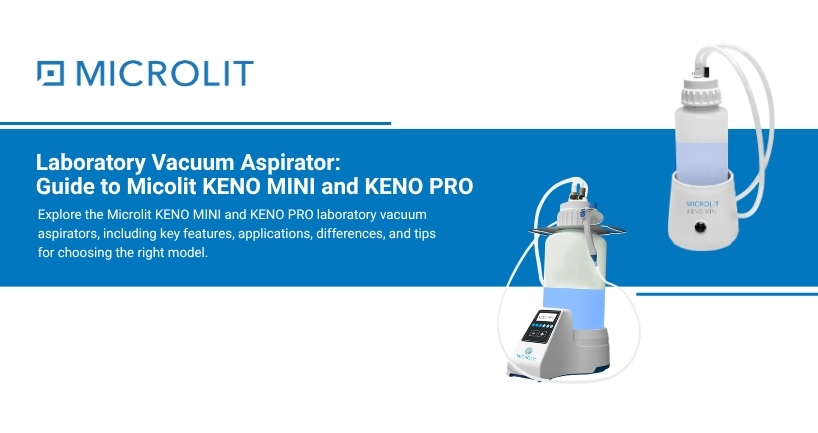
A laboratory vacuum aspirator provides controlled negative pressure for aspirating, transferring, and collecting liquid samples and laboratory waste. Microlit’s KENO range is designed for laboratory liquid aspiration, with the KENO MINI focused on compact, portable use and the KENO PRO offering additional features for more demanding laboratory workflows.
What Is a Laboratory Vacuum Aspirator?
A laboratory vacuum aspirator is a liquid-handling device that uses controlled vacuum pressure to remove and collect liquids from laboratory vessels such as tubes, dishes, bottles, flasks, and plates.
Instead of manually removing liquid, the aspirator creates negative pressure that draws liquid through the aspiration tubing into a collection bottle. KENO systems use a closed aspiration setup with collection bottles, tubing, connectors, and aspiration accessories.
How Does a Laboratory Vacuum Aspirator Work?
The basic process is:
- Vacuum generation: The aspirator creates negative pressure within the collection system.
- Liquid aspiration: The operator uses the hand controller and appropriate aspiration accessory to draw liquid.
- Collection: Aspirated liquid is transferred into the polypropylene collection bottle.
- Containment: The closed bottle and connected components help contain the aspirated liquid.
- Waste handling: The collection bottle can then be emptied, cleaned, disinfected, or sterilized according to the applicable product instructions.
Microlit’s KENO MINI manual specifically describes controlled negative pressure for aspiration, transfer, and collection of liquid samples in laboratory environments.
Where Are Vacuum Aspirators Used?
Microlit identifies KENO aspirators for laboratory environments including research, diagnostic, educational, and industrial quality-control laboratories. The KENO product pages also identify applications such as cell culture, microbiology, molecular biology, and laboratory waste management.
Common laboratory tasks include:
- Removing liquid from cell culture vessels
- Aspirating laboratory liquid waste
- Removing supernatants
- Liquid removal from tubes, dishes, bottles, and plates
- Routine liquid aspiration during laboratory workflows
The exact accessory and configuration should be selected according to the vessel, liquid, and laboratory procedure.
Key Features to Consider When Choosing a Laboratory Vacuum Aspirator
1. Vacuum control
Look for a vacuum system appropriate for the sensitivity of the application. KENO PRO provides adjustable vacuum control, while Microlit’s product pages specify adjustable vacuum capability for the KENO range.
2. Collection capacity
Choose the collection-bottle size according to the volume and frequency of liquid aspiration. KENO MINI is available with 0.5 L and 1 L polypropylene bottles, while KENO PRO is specified with 2 L and 4 L polypropylene bottles on its product page.
3. Portability and workspace
For laboratories with limited bench space or a need to move the aspirator between work areas, size and power configuration are important considerations.
KENO MINI uses a built-in rechargeable lithium battery and has a compact footprint.
4. Liquid-level protection
KENO PRO includes an intelligent level sensor designed to detect when the collection bottle reaches capacity.
5. Containment and connections
Closed connections, appropriate filtration, compatible tubing, and secure collection bottles are important when handling laboratory liquids. KENO PRO includes self-closing quick coupling, while the KENO MINI uses a cap with built-in connectors.
6. Accessories
Consider the type of vessels and volumes you will aspirate. Microlit offers hand controllers and different single- and multi-channel needle/accessory configurations for KENO systems.
Microlit KENO MINI vs KENO PRO
|
Feature |
KENO MINI |
KENO PRO |
|
Primary positioning |
Compact, space-saving vacuum aspirator | Vacuum aspirator for demanding laboratory environments |
|
Models |
K-M1 & K-M0.5 | K-P4, K-E4, K-P2 |
| Power | Built-in rechargeable lithium battery |
DC 24 V, 1.2 A; 100–240 VAC adapter |
|
Collection bottle |
0.5 L / 1 L polypropylene | 2 L / 4 L polypropylene |
| Vacuum range* | 0 to -850 mbar, adjustable |
0 to -850 mbar, adjustable |
|
Maximum air flow* |
15 L/min | 15 L/min |
| Liquid flow | 23–40 mL/sec |
23–40 mL/sec |
|
Noise |
<65 dB at maximum vacuum | <65 dB at maximum vacuum |
| Motor | Brushless DC motor |
Brushless DC motor |
|
IP rating |
IP41 | IP41 |
| Auto shut-off | Yes |
Yes |
|
Intelligent level sensor |
Not listed on product page | Yes |
| Self-closing quick coupling | Not listed on product page |
Yes |
|
Eco-Control |
Not listed on product page | Yes |
| Best fit | Compact and mobile laboratory workflows |
Larger-volume and feature-rich laboratory workflows |
Which KENO Model Is Right for Your Laboratory?
Choose KENO MINI if you need:
- A compact vacuum aspirator for limited workspace
- A rechargeable, portable configuration
- 0.5 L or 1 L liquid collection capacity
- A solution for routine laboratory liquid aspiration
- A system suitable for research, diagnostic, educational, or industrial QC laboratory environments
KENO MINI is particularly appropriate when space, portability, and smaller collection capacity are important purchasing considerations.
Choose KENO PRO if you need:
- Larger 2 L or 4 L collection bottles
- Intelligent liquid-level detection
- Self-closing quick coupling
- Eco-Control
- Adjustable vacuum control
- A configuration intended for more demanding laboratory workflows
KENO PRO is a stronger fit when larger collection capacity and additional control/containment features are priorities.
Best Practices and Safety Considerations
Laboratory vacuum aspiration should always be performed according to the instrument manual, laboratory SOPs, and applicable safety requirements.
- Use the aspirator only in appropriate indoor laboratory environments.
- Operators should be trained laboratory personnel.
- Wear appropriate PPE.
- Inspect the instrument, tubing, adapter, filters, and accessories before use.
- Use compatible collection containers and liquids.
- Do not use the system with flammable, explosive, or highly volatile substances.
- Do not operate the device in hazardous or ATEX-classified environments.
- Do not use it for direct patient aspiration or clinical suction procedures.
- Do not operate continuously while unattended.
- Ensure tubing and connections are secure and free from leaks, twisting, or blockage.
- Release the vacuum before opening the collection bottle.
- Disconnect the instrument before cleaning or maintenance.
- Use only compatible cleaning and disinfecting agents.
- Only components specifically identified by Microlit as autoclavable should be autoclaved.
- Replace filters, tubing, or other consumables when required.
- Do not modify or repair the instrument without authorization.
These precautions are based on Microlit’s KENO operating documentation.
Frequently Asked Questions
1. What is a laboratory vacuum aspirator?
A laboratory vacuum aspirator uses controlled negative pressure to aspirate, transfer, and collect liquids during laboratory procedures.
2. What is a vacuum aspirator used for?
It can be used for laboratory liquid aspiration and waste handling, including applications such as cell culture, microbiology, molecular biology, diagnostics, and routine laboratory workflows.
3. Can KENO aspirators be used for cell culture?
Yes. Microlit identifies cell culture among the applications for its KENO vacuum aspirators.
4. What is the difference between KENO MINI and KENO PRO?
KENO MINI emphasizes compactness, portability, and rechargeable battery operation, while KENO PRO provides larger collection capacity and additional features including a level sensor, self-closing coupling, and Eco-Control.
5. What collection-bottle sizes are available?
KENO MINI is listed with 0.5 L and 1 L polypropylene bottles. KENO PRO is listed with 2 L and 4 L polypropylene bottles.
6. Is KENO MINI rechargeable?
Yes. The Microlit USA product page specifies a built-in rechargeable lithium battery for KENO MINI.
7. Does KENO PRO have liquid-level detection?
Yes. KENO PRO includes an intelligent level sensor for detecting the collection-bottle level.
8. Can KENO aspirators be used with different aspiration accessories?
Yes. Microlit lists hand controllers and multiple single- and eight-channel aspiration accessories, including configurations for different pipette tips.
9. Can the KENO system be used with chemicals?
Only liquids compatible with the device materials should be aspirated. Microlit specifically states that incompatible liquids, including strong solvents, should not be aspirated unless compatibility has been verified with the manufacturer.
10. Is KENO suitable for direct patient suction?
No. Microlit’s operating manual states that KENO is not intended for direct patient aspiration or clinical suction procedures.
Final Buying Guide
Choose your KENO vacuum aspirator based on four primary factors:
Choose KENO MINI when your priority is a compact, rechargeable solution for routine laboratory aspiration and smaller collection volumes.
Choose KENO PRO when your laboratory requires larger collection capacity and additional features such as liquid-level sensing, self-closing coupling, and Eco-Control.
Before purchasing, confirm your required collection volume, aspiration accessories, liquid compatibility, workspace constraints, operating environment, and required safety/containment configuration.
Need Help Choosing the Right KENO Aspirator?
Explore the Microlit KENO range or contact Microlit USA for product and configuration guidance.