




 0
Precision, efficiency and consistency are fundamental to modern laboratory operations. Whether working in pharmaceutical research, biotechnology, clinical diagnostics, microbiology or academic laboratories, selecting the right liquid handling equipment can significantly influence workflow efficiency and user experience.
Among the commonly used liquid handling devices, the terms pipette gun, pipette controller and pipette filler are often used interchangeably. However, understanding their operating mechanisms, functionalities and applications can help laboratory professionals make informed purchasing decisions.
So, what differentiates these devices, and which one is best suited to your laboratory requirements?
Let’s explore.
1. What Is a Pipette Gun?
A pipette gun is an informal term commonly used to describe a handheld device that assists with liquid aspiration and dispensing through compatible laboratory pipettes. Depending on the manufacturer, it may refer to a manual or electronic pipette handling device.
Traditional manual pipette fillers typically use a bulb, wheel or mechanical suction mechanism to draw and release liquids. They offer a straightforward approach to liquid transfer without requiring electrical power.
Key characteristics:
- Manual operation using mechanical suction mechanisms.
- Requires physical effort for aspiration and dispensing.
- Simple operating mechanism.
- Suitable for basic liquid transfer applications.
Typical applications: Routine liquid transfers, educational laboratories and workflows involving relatively low-frequency pipetting.
While manual devices can be practical for basic requirements, repetitive pipetting may increase operator effort and make consistent speed control more challenging.
2. What Is a Pipette Controller?
A pipette controller is a handheld electronic device designed to assist users in aspirating and dispensing liquids through serological or volumetric pipettes.
Unlike traditional manual fillers, electronic pipette controllers use a motor-driven mechanism to facilitate liquid transfer. Users can operate the device through buttons or triggers, with speed control depending on the instrument’s design.
Key characteristics:
- Motor-assisted aspiration and dispensing.
- Controlled liquid transfer.
- Ergonomic handheld operation.
- Rechargeable battery in cordless models.
- Compatibility with specified pipette sizes.
Electronic pipette controllers are particularly useful in laboratories where liquid transfers are performed frequently. They help reduce repetitive manual effort and offer greater operational convenience.
3. What Is a Pipette Filler?
A pipette filler is a device designed to facilitate the aspiration and dispensing of liquids through compatible laboratory pipettes.
The category includes both manual and electronic devices. Modern electronic pipette fillers incorporate motorised pumping mechanisms, speed control and additional features designed to simplify liquid handling.
For laboratories looking for improved operational control and convenience, electronic pipette fillers offer several advantages over conventional manual alternatives.
Key characteristics:
- Facilitates controlled aspiration and dispensing.
- Available in manual and electronic configurations.
- Supports different pipette capacities depending on the model.
- Reduces repetitive manual effort.
- May offer adjustable speed and multiple dispensing modes.
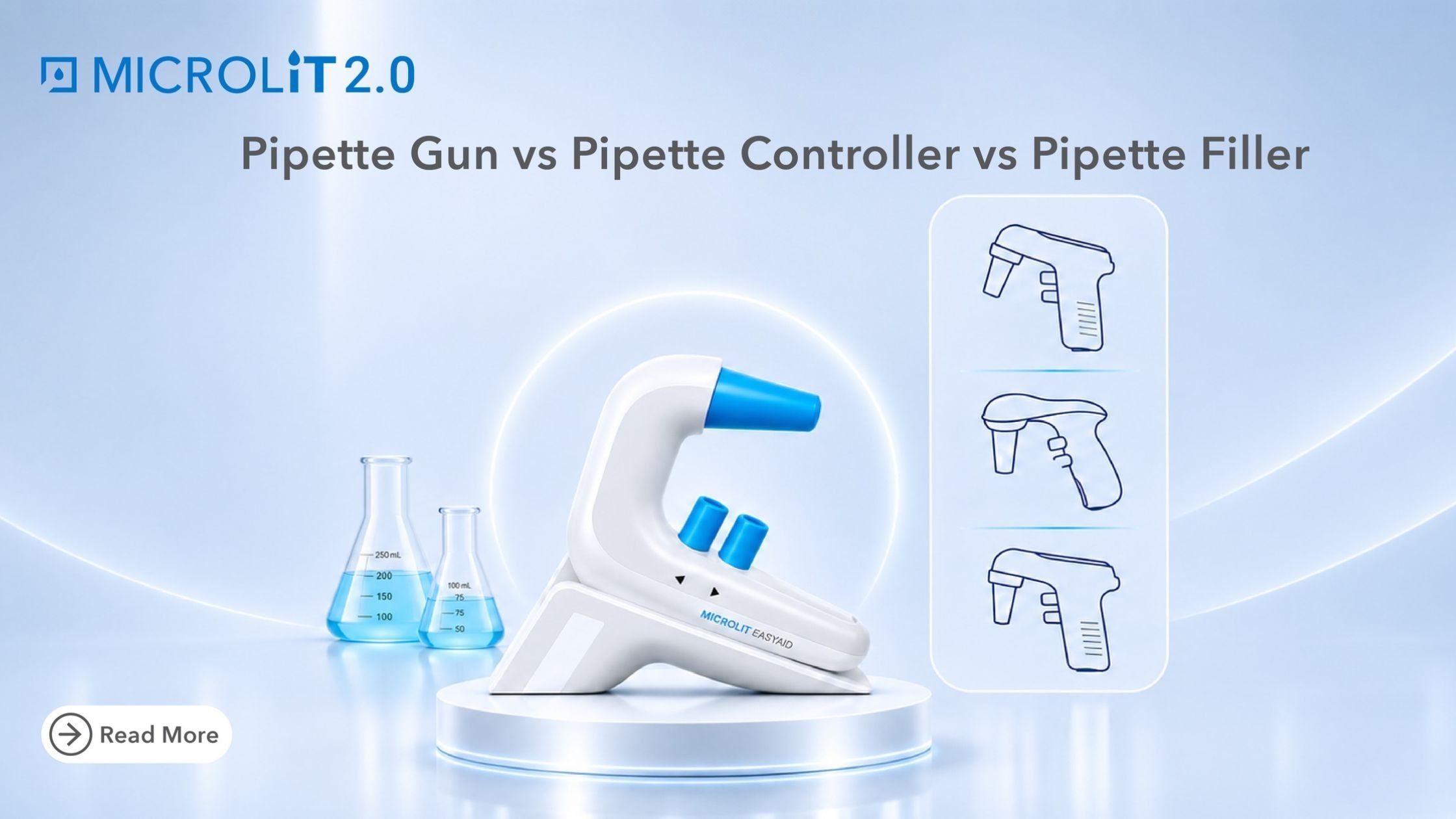
An advanced electronic pipette filler, such as Microlit EASYAID, takes this functionality further through its integrated Solenoid Valve system and Force Touch Technology.
Pipette Gun vs Pipette Controller vs Pipette Filler: Key Differences
Although these terms are frequently used in laboratory conversations, their exact meanings can vary between manufacturers. The most important distinction is the operating mechanism and functionality of the device.
|
Parameter |
Manual Pipette Filler | Electronic Pipette Controller | Electronic Pipette Filler |
| Operating mechanism | Manual | Motorised |
Motorised |
|
Aspiration |
Manual suction | Motor-assisted | Motor-assisted |
| Dispensing | Manual | Controlled |
Controlled |
|
Speed control |
Operator-dependent | Model-dependent | Model-dependent |
| Power requirement | Not required | Usually rechargeable |
Usually rechargeable |
|
User effort |
Higher | Reduced | Reduced |
| Applications | Basic liquid transfer | Routine laboratory workflows |
Controlled liquid handling |
When choosing between these devices, laboratory professionals should consider pipette compatibility, aspiration and dispensing control, filtration, ergonomics and battery performance rather than relying solely on product terminology.
What Should You Look for in an Electronic Pipette Filler?
Selecting an electronic pipette filler involves evaluating several important factors.
- Pipette Compatibility
The instrument should accommodate the pipette capacities commonly used in the laboratory. Compatibility with standard glass and plastic pipettes can provide additional flexibility.
- Aspiration and Dispensing Control
Adjustable speed control allows users to regulate liquid movement according to their application requirements and pipette capacity.
- Contamination Protection
A hydrophobic membrane filter helps protect the instrument against aerosol contamination and accidental liquid entry.
- Ergonomics and Ease of Operation
A lightweight, comfortable handheld instrument can make repetitive liquid handling tasks more convenient.
- Battery Performance
Battery capacity, charging time and continuous operating duration are important considerations when selecting a cordless electronic device.
- Dispensing Modes
Gravity dispensing and blow-out dispensing offer different approaches to liquid release. These features can be particularly useful when working with different pipette types and application requirements.
Meet Microlit EASYAID: An Electronic Pipette Filler Designed for Controlled Liquid Handling
For laboratories looking to move beyond conventional manual pipette fillers, Microlit EASYAID offers an advanced electronic approach to routine liquid handling.
Designed for use with standard glass and plastic pipettes ranging from 1 ml to 100 ml, EASYAID combines an intuitive operating interface with technologies designed to support controlled aspiration and dispensing.
Its distinguishing features include:
Force Touch Technology with Hall Sensors
The plunger buttons incorporate magnets that interact with Hall Sensors mounted on the PCB. This technology enables users to regulate aspiration and dispensing speed by adjusting the pressure applied to the buttons, providing intuitive operational control.
Solenoid Valve System
The integrated Solenoid Valve system facilitates controlled filling and dispensing of serological pipettes, supporting efficient and convenient liquid handling.
0.2-Micron PTFE Hydrophobic In-Line Membrane Filter
The hydrophobic membrane filter helps prevent aerosol contamination and accidental liquid entry into the instrument, supporting safer laboratory operation.
Universal Silicon Collet Adapter
Featuring internal knurling, the universal adapter securely accommodates compatible glass and plastic pipettes ranging from 1 ml to 100 ml, including pipettes from different manufacturers.
1-Inch Tempered Monochrome OLED Display
The easy-to-read display provides a clear operating interface and is designed to withstand accidental impacts, scratches and chemical spills.
Programmable Pipette Capacity Selection
Users can select from seven pipette capacities: 1 ml, 2 ml, 5 ml, 10 ml, 25 ml, 50 ml and 100 ml. The selected capacity adjusts the operating speed range for smooth aspiration and dispensing.
Gravity and Blow-Out Dispensing
EASYAID offers gravity and blow-out dispensing options. Gravity mode allows liquid dispensing without activating the pump, while blow-out mode supports complete liquid expulsion when required by the pipette type and application.
Autoclavable Components
The collet assembly and 0.2-micron in-line membrane filter can be autoclaved at 121°C and 15 psi for 10–15 minutes, supporting laboratory hygiene and maintenance requirements.
With a lightweight design weighing approximately 238 g and up to eight hours of continuous battery operation, EASYAID is designed to support convenient everyday laboratory use.
Which Pipette Handling Device Should You Choose?
The right choice depends on your laboratory’s workflow, frequency of use, pipette compatibility and desired level of operational control.
- For basic liquid transfers: A conventional manual pipette filler may be sufficient.
- For frequent liquid handling: An electronic pipette controller can reduce repetitive manual effort.
- For controlled and convenient liquid handling: An electronic pipette filler with adjustable speed control, filtration and multiple dispensing modes can be a valuable investment.
Ultimately, the objective is not simply to select a device based on what it is called, but to identify the technology that best supports your laboratory’s requirements.
Conclusion
Pipette guns, pipette controllers and pipette fillers serve the common purpose of facilitating liquid transfer, but their operating mechanisms and capabilities can vary considerably.
As laboratories increasingly prioritise workflow efficiency, contamination prevention and controlled liquid handling, electronic pipette fillers are becoming an important part of modern laboratory equipment.
Microlit EASYAID brings together Force Touch Technology, an integrated Solenoid Valve system, universal pipette compatibility and multiple dispensing options in one compact electronic pipette filler.
Explore Microlit EASYAID and discover a more controlled approach to everyday laboratory liquid handling.
Explore the product: https://www.microlit.us/product/easyaid-electronic-pipette-filler/
Have questions about choosing the right pipette filler for your laboratory? Contact the Microlit team at info-usa@microlit.com