• Multiple Offers
    Multiple Offers
  • Support
    Real-Time Support
  • Free Replacement
    1-Year Free Replacement Warranty
  • (732) 321-0852

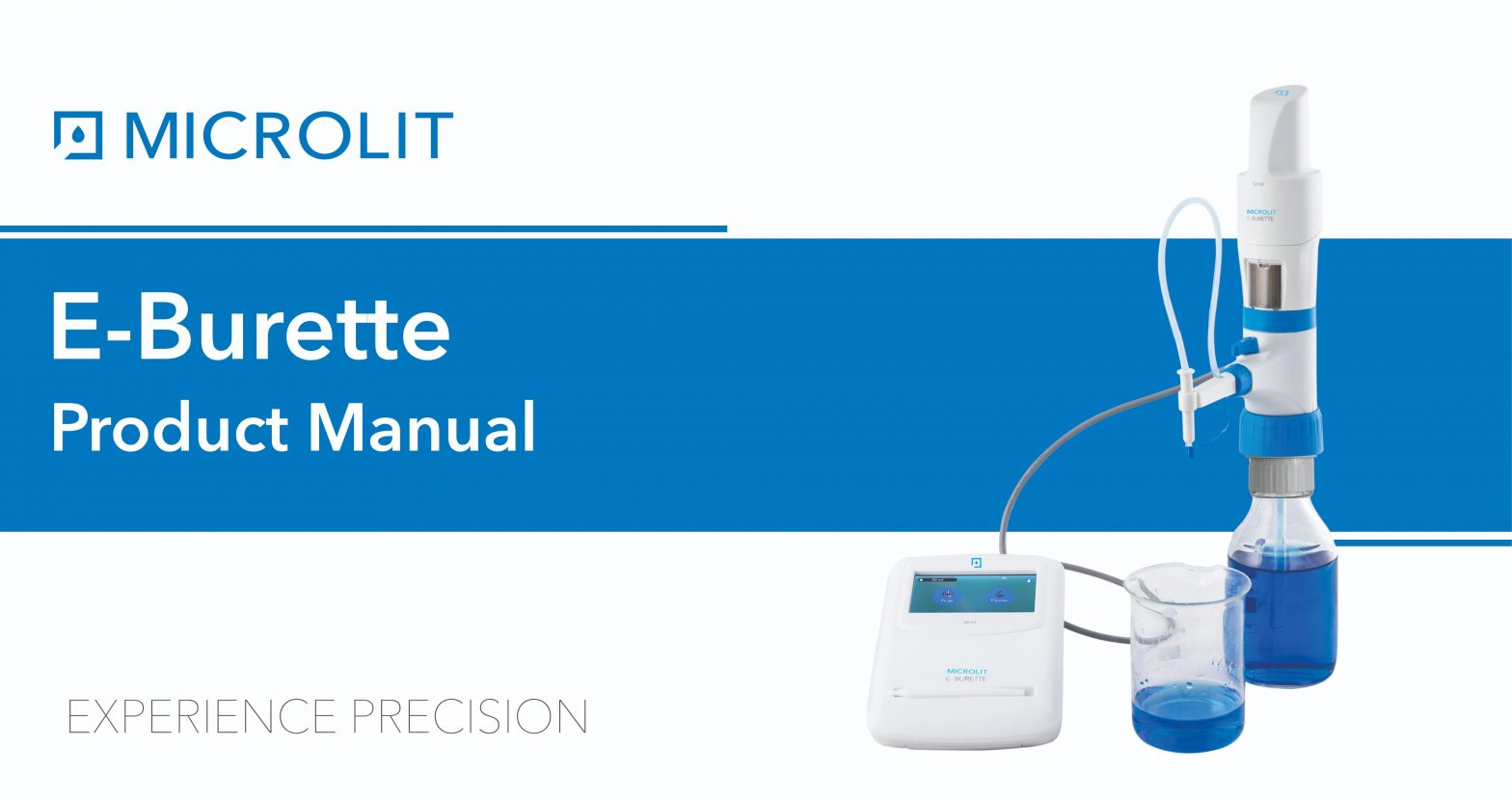
E-Burette Product Manual

1.  Intended Use of the Instrument

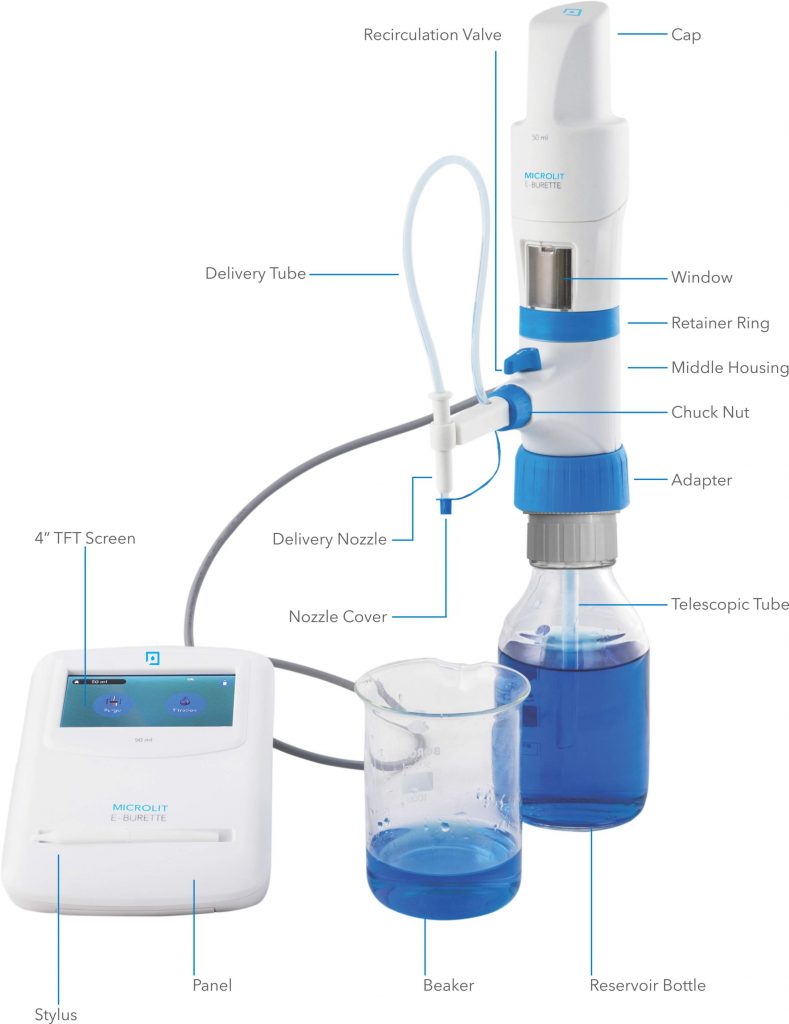
MICROLIT E-BURETTE is a state-of-the-art Motor Operated Burette with sophisticated features and functionality. It is intended for use in laboratories and the field for easy, safe and accurate titrations.

2. Product Specifications

Performance Data 10 ml 25 ml 50 ml
Unit Type Microprocessor-controlled motorized piston lift system with recirculation valve
Volume Ranges 0.005 ml – 99.99 ml (Max piston lift 10 ml, automatic addition) 0.01 ml – 250 ml (Max piston lift 25 ml, automatic addition) 0.01 ml – 500 ml (Max piston lift 50 ml, automatic addition)
Volume Accuracy A= 0.2%, CV = 0.07% A = 0.2%, CV = 0.07% A= 0.2%, CV = 0.07%
Operating Temperature +10 °C to +40 °C (from 50 °F to 104 °F)
Power Supply 18 V, 3 A
Battery Operation One complete battery charge gives 3 hours (approx.) of continuous operation, (Battery capacity indicated on TFT display and charging time 6.5 hrs.)
Quality Control In compliance with DIN EN ISO 8655-3
Touchscreen 4” TFT screen
PC Interface Mini USB Cable
Languages Available in 4 languages (English, Spanish, German and French)

3. Safety Instructions

This instrument may sometimes be used for operations involving hazardous materials and equipment. It is beyond the scope of this manual to address all of the potential risks associated with its use in such applications. It is the sole responsibility of the user to consult and establish appropriate safety and health practices and determine the applicability of regulatory limitations, prior to the usage of this instrument.

  • Please read the following instructions carefully.
  • Read and understand this Operation Manual thoroughly before using the instrument.
  • Follow general and safety instructions for hazard prevention. E.g., always wear protective clothing, protective gear for the eyes and hands.
  • Carefully observe the specifications provided by reagent manufacturers.
  • When dispensing inflammable fluids, avoid the built up of static charge. Make sure that you do not dispense into plastic vessels and do not wipe the instrument/equipment with a dry cloth.
  • Use the instrument only for dispensing liquids, with strict regard to the defined limitations of use and operating constraints. (Refer to section 4)
  • Observe operating exclusions. When in doubt, contact the manufacturer or supplier.
  • Always use the instrument in such a way that neither the user nor any other person is in danger. While dispensing, the discharge tube must always point away from you or any other person. Only dispense into appropriate vessels and avoid splashes.
  • Do not press the piston when the discharge tube closure is attached.
  • Do not remove the discharge tube while the dispensing cylinder is being filled.
  • Reagents can accumulate in the cap of the discharge tube. Thus, clean it regularly.
  • Do not carry the mounted instrument by the cylinder sleeve or the valve block. Breakage or loosening of the cylinder may lead to personal injury.
  • Use only original accessories and spare parts.
  • Do not attempt to make any technical alterations. Do not dismantle the instrument any further than is described in the Operation Manual.
  • Always check the instrument for visual damage before use.
  • If there is any sign of a potential malfunction (e.g. piston difficult to move, stuck valve or leakage), immediately stop dispensing.
    Consult the ‘Troubleshooting’ section of this Operation Manual and contact the manufacturer if needed. (Refer to section 18)

4. Functions and Limitations of Use

MICROLIT E-BURETTE is designed for dispensing liquids directly from the reservoir bottle. It is calibrated in accordance with the guidelines of the DIN EN ISO 8655–3. When the instrument is correctly used, the dispensed liquid comes into contact with only the following chemically resistant materials: PTFE, FEP and Borosilicate glass.

A.  CE Marking:

This sign certifies that the product meets the requirements of the EC directive and has been tested according to the specified test methods.

B.  Physical Limits

MICROLIT E-BURETTE is designed for titrating liquids, observing the following physical limits:

  • Maintain instrument and reagent between +10 °C to +40 °C (from 50 °F to 104°F).
  • Maintain reagent vapor pressure up to 600 mbar (maximum). Aspirate slowly above 300 mbar in order to prevent the liquid from boiling.
  • Kinematic viscosity upto 500 mm2/s. (dynamic viscosity [mPas] = kinematic viscosity [mm2 /s] x density [g/cm³])
  • Relative air humidity between 20% and 90%.
  • Use fluids with density upto 2.2 g/cm³.

C.  Operating Limitations

  • Chlorinated and fluorinated hydrocarbons or chemical combinations which form deposits may make it difficult for the piston to move or jam it. If the piston becomes too difficult to move, immediately clean the instrument. (Refer to section 17)
  • While dispensing inflammable fluids, avoid the built up of static charge. Make sure that you do not dispense into plastic vessels and do not wipe instruments with a dry cloth.
  • MICROLIT E-BURETTE is designed for general laboratory applications and complies with relevant standards, like DIN EN ISO 8655-3. Please check the compatibility of the instrument for a specific application (e.g. trace material analysis, food sector etc.). Approvals for specific applications, like production and administration of food, pharmaceuticals and cosmetics are not available.

5. Operating Exclusions

  • Do not use the instrument with:
  • Liquids that attack FEP, PFA and PTFE (e.g. dissolved Sodium Azide*).
  • Liquids that attack borosilicate glass (e.g. Hydrofluoric acid).
  • Hydrochloric acid > 40% and Nitric acid >70%.
  • Tetrahydrofuran or Oxolane.
  • Trifluoroacetic acid.
  • Explosive liquids (e.g. Carbon Disulfide).
  • Suspensions (e.g. of charcoal) as the solid particles may clog or
    damage the instrument.
  • Liquids that attack PP (cap).
  • An aggressive atmosphere, e.g. HCl fumes.
    * The permissible concentration of dissolved Sodium Azide is not more than 0.1%

6. Storage Conditions

Store the instrument and accessories in a clean, cool and dry place. Storage temperature from –20 °C to +50 °C (from –4 °F to 122 °F) is advised with relative humidity between 5% and 95%.

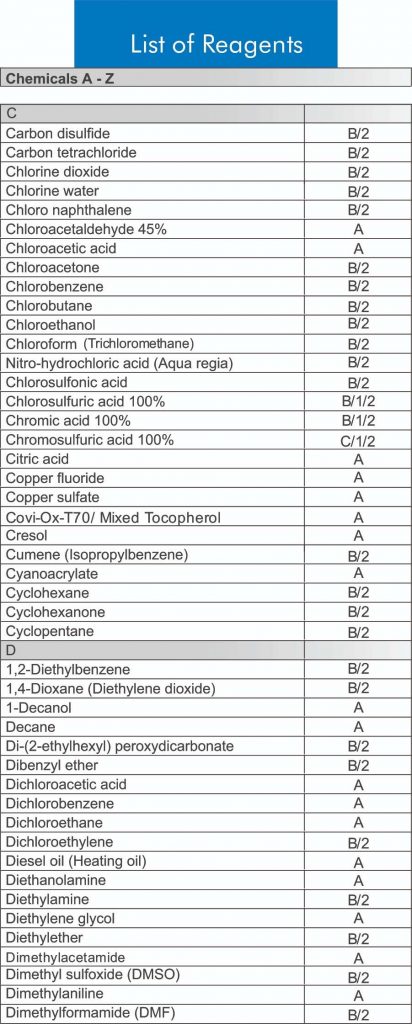
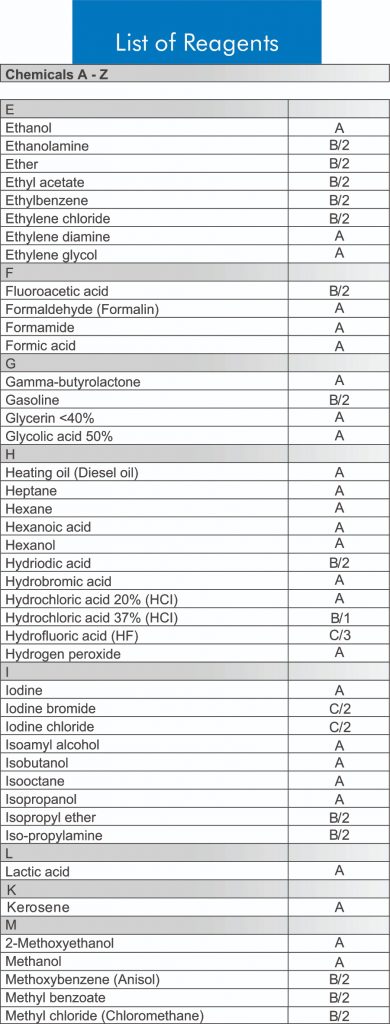
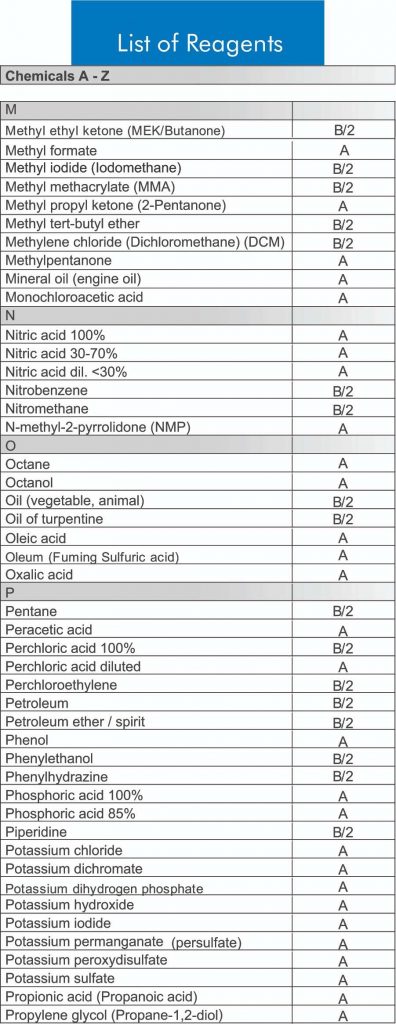
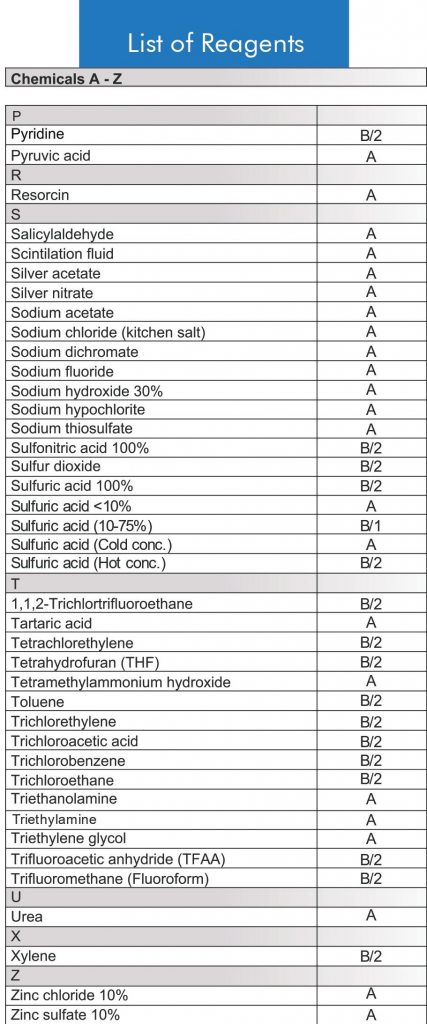
7. List of Recommended Reagents

Chemicals from A to Z
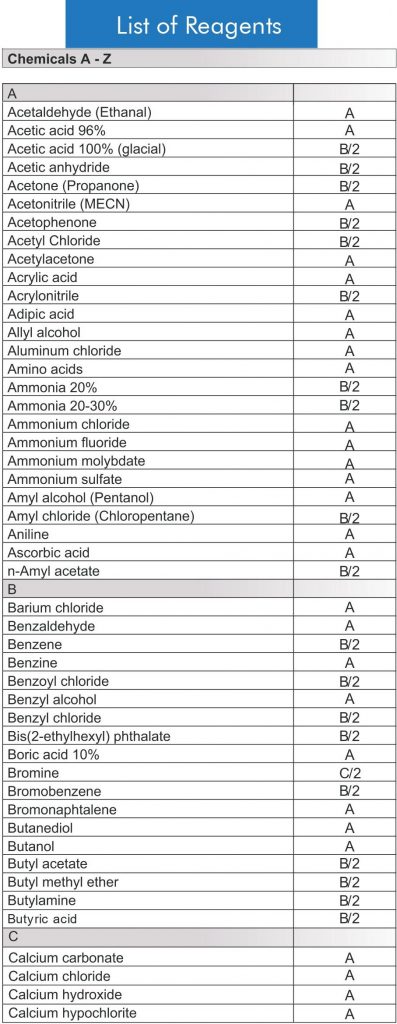
The following tables enlist the most frequently used reagents. They provide useful information for the safe and efficient use of MICROLIT E-BURETTE. All the safety precautions and recommendations within this Operation Manual must be followed carefully.

Code explanations
A = Good resistance
B = Acceptable with limitations
C = Not recommended
1 = Acid vapours (better resistance with lower concentration).
Do not leave the instrument on the bottle.
Rinse with distilled water after use.
2 = Risk of damage, softening or discoloration of external parts through vapours.
Do not leave the instrument on the bottle.
Rinse with distilled water after use.
3 = Chemical degradation of glass parts (plunger/barrel)
 

0006 Copy
0008

8. First Steps

First and foremost – check whether everything is there in the package.
Verify that the package includes:

1. Operation Manual

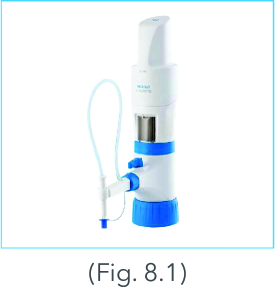
2. 10, 25 or 50 ml MICROLIT E-BURETTE
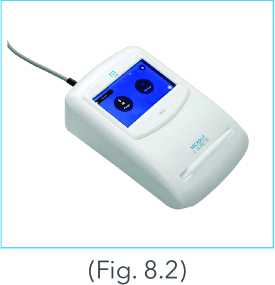
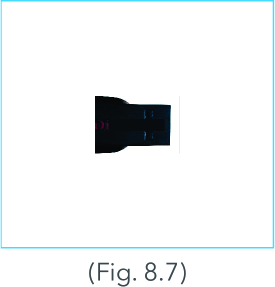
3. Control Panel

4. Telescopic Tube

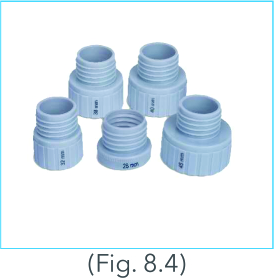
5. Bottle Adapters (28, 32, 38, 40, 45 mm)
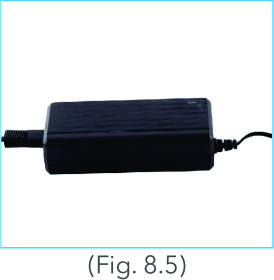
6. Charging AC Adaptor

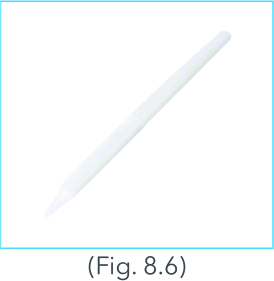
7. Control Panel Stylus

8. USB Drive for software & driver

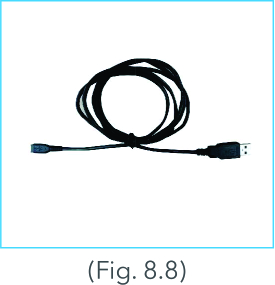
9. Mini USB Cable

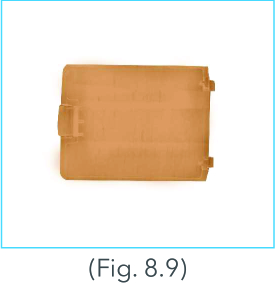
10. Extra Amber Coloured Windows

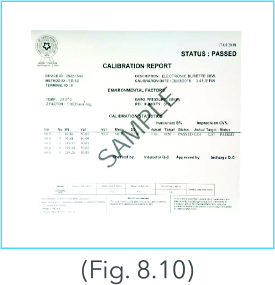
11. Calibration Certificate

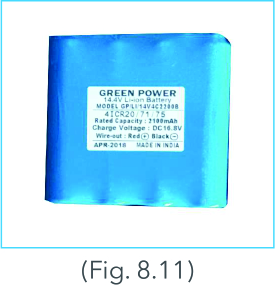
12. 14.4 V, 2000 mAh Li-ion Rechargeable Batteries
9. Initializing

Wear protective clothing, protective gear for the eyes and hands. Follow all safety instructions and observe limitations of use and operating constraints. (Refer to section 4 and 5)

Connecting the batteries

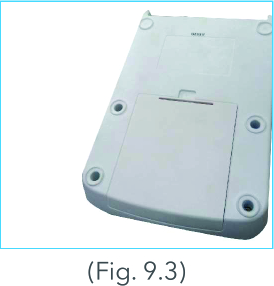
1. Open the battery panel at the back of the control panel
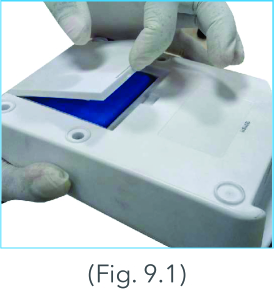
2. Connect the batteries to the panel wire by inserting the battery connector into the panel connector firmly. It locks with a ‘click’ sound.
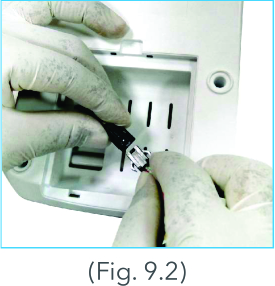
3. Close the panel

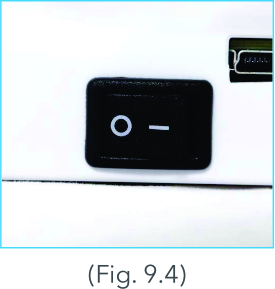
4. Press the ON/OFF button

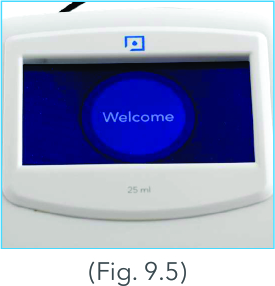
5. The screen will display ‘Welcome’.

NOTE:
In order to replace the batteries, press the lock button to disengage the battery lock and remove the old batteries.

10. Setting Up

Adjust the length of the Telescopic tube (FEP tube) to fit your particular reservoir.
If you require a longer tube, it is provided on request.

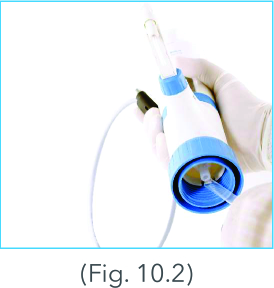
1. Adjust the length of the Telescopic tube (FEP tube) to fit your particular reservoir. If you require a longer tube, it is provided on request.

2. Fix the Telescopic tube as shown. The tube’s ends have different diameters – fix it from the wider end.
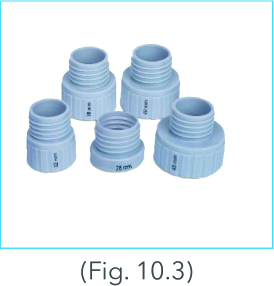
3. Choose the correct adapter for the bottle. The threaded platform base of MICROLIT E-BURETTE has a 30 mm screw thread. Five adapters are supplied to suit containers with a 28, 32, 38, 40, 45 mm and
30 mm (inbuilt adapter) screw neck.
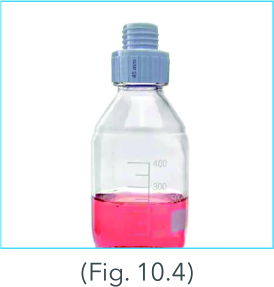
4. Fix the adapter on the reservoir bottle by screwing it in clockwise direction
5. Mount the instrument. Screw it to the reservoir by applying gentle hand torque applied to the threaded platform base only. In case of removal, apply the same technique to the base, in the opposite direction.

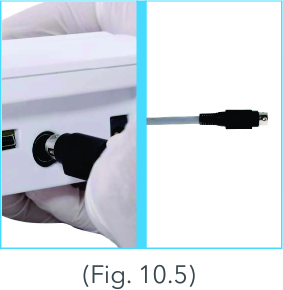
6. Connect the cable from the instrument housing to the port at the back of the control panel with a firm push, as shown. Check for the cable position. The flat surface of the connector with an arrow mark will face down.
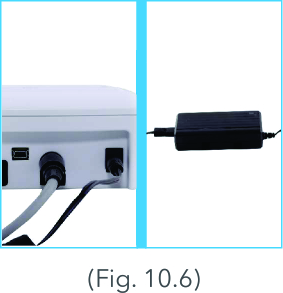
7. If charging is required, insert the charging pin at the back of the control panel and connect the power cord with the AC adaptor firmly and then plug the two pin power cord to the 220 V power supply
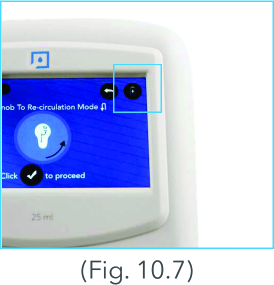
8. The battery indicator will show the charging symbol.
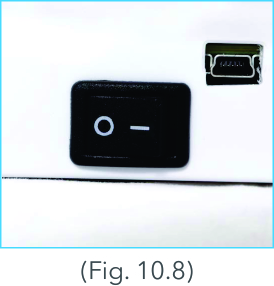
9. The E-Burette is now ready to be switched on. Press the ON button (of the ON/OFF button) at the back of the control panel to switch on the control panel.
Transporting the instrument

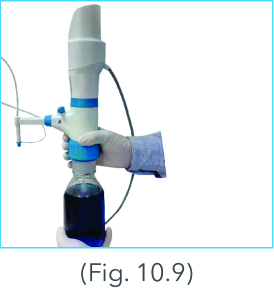
When mounted to a reagent bottle, always carry the instrument as shown and always store it in the upright position.
11. Computer Connectivity

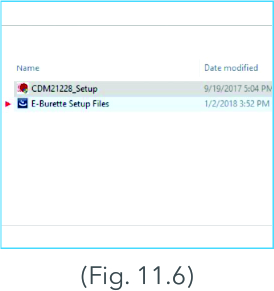
Insert the pen drive provided with the package in your PC/Laptop for driver files and software. Please note that there are two set up files in the pen drive.

  • CDM21228
  • E-Burette Setup Files

Procedure to install the driver & software:

1.  Installing the CDM21228 driver files:

I. Double click the CDM21228 setup icon
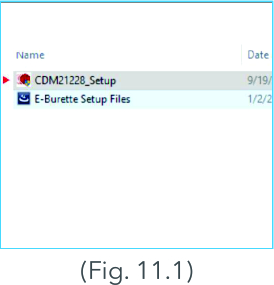
II. Press the Extract tab from the FTDI CDM driver window.
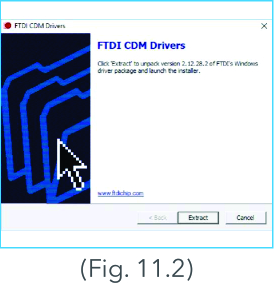
III. Click the Next button for installing the device driver
IV. Click to accept the licence agreement.
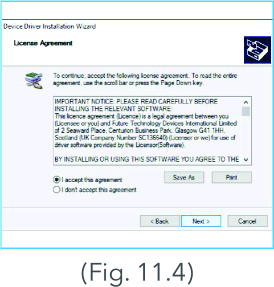
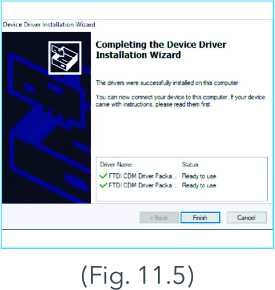
V. Then, click the Finish button on the device driver installation wizard.
2. Installing the instrument software

I. Double click the E-BURETTE setup icon.
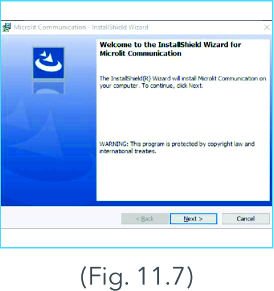
II. Click Next to start the Install Shield Wizard for MICROLIT Communication window.
III. Click Next to choose the destination folder of the software files.
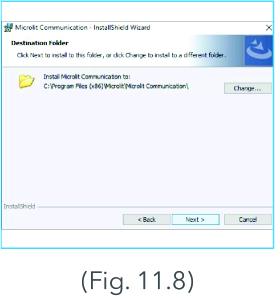
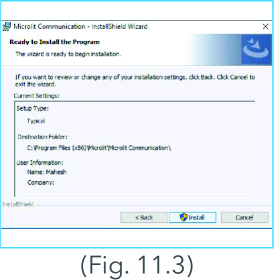
IV. Click Install for the ready to install program window.
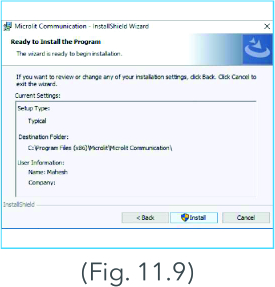
V. Click Next for the user account control window.
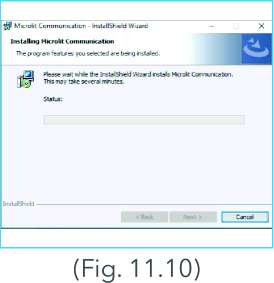
VI. Click Finish for the Install Shield Wizard completion window.
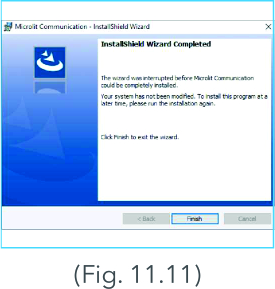
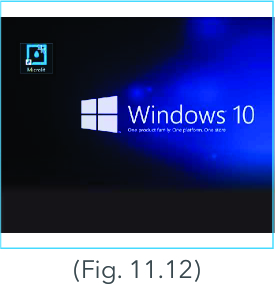
VII. MICROLIT Communication icon will then appear on the desktop.
12. Operating the instrument

Switching on the Control Panel

1. Switch on the instrument using the ON/OFF switch at the back of the control panel.

2. When it boots, the instrument will warn the user to switch the knob to recirculation mode.
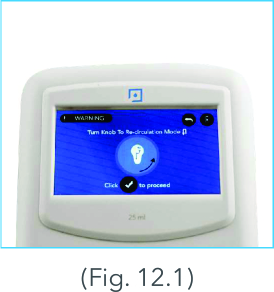
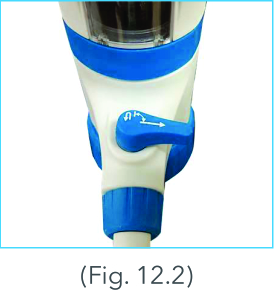
3. Turn the knob to re-circulation mode and click the tick mark on the control panel screen when ready.
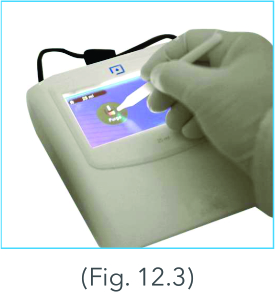
4. The instrument will reset automatically. It is now ready to use.

Purging

This step is recommended before using the Burette to ensure bubble free dispensing.

1. Click on the purging mode from the Home Screen on the control panel.
2. The screen on the control panel will warn the user to turn the knob to re-circulation mode.
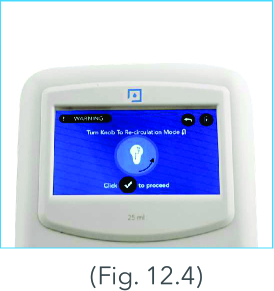
3. Turn the knob to re-circulation mode and click the tick mark on the control panel screen when ready
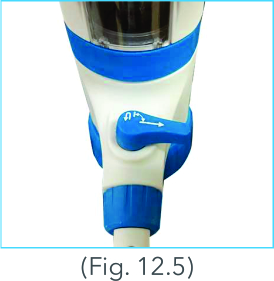
4. The E-BURETTE will purge automatically. If the device is still not properly purged, go to step 1 and repeat the procedure till no large air bubble is visible below the piston.

A few air bubbles up to 1 mm in size are permissible.

Titration

Wear protective clothing, protective gear for the eyes and hands. Liquid may accumulate in the cap. Follow all safety instructions and observe limitations of use and operating constraints. (Refer to section 4 and 5)

1. Remove cap from the discharge tube.
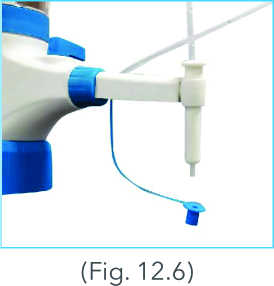
2. Click on the Titration mode on the home screen.
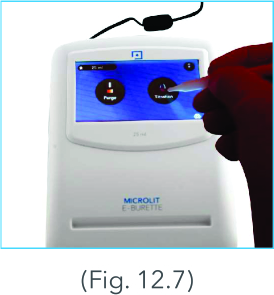
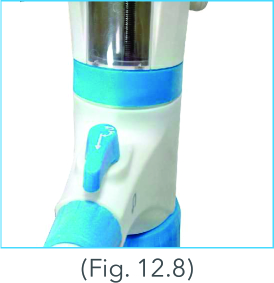
3. The screen on the control panel will warn the user to turn the knob to titration mode.

4. Turn the knob clockwise to set at titration mode and click the tick mark on the screen of the control
panel when ready
5. Place the discharge tube orifice against the inner wall of a suitable receiving vessel.

6. Now fill the barrel from the titration screen by clicking the FILL button. By pressing the STOP button, the filling volume can be stopped as and when you need to.
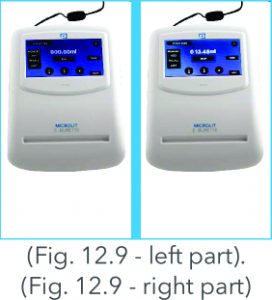
7. Three dispensing speeds are provided, including drop-wise dispensing, which allows the user to achieve the end point very accurately.

I. Fast mode : In this mode, the dispensing speed is 2.2 ml/sec
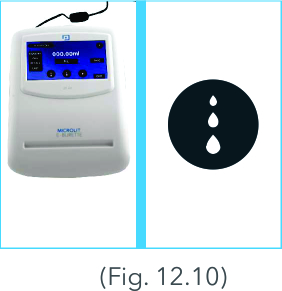
II. Medium mode : In this mode, the dispensing speed is 0.75 ml/sec
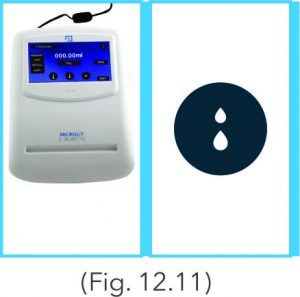
III. Dropwise mode : In this mode, the dispensing speed is 0.025 ml/sec
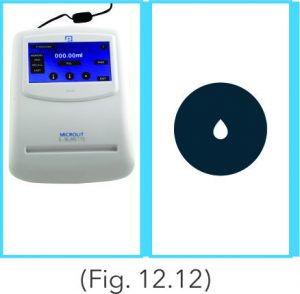
8. Dispensing can be performed by touching the screen and stops immediately when the touch is removed.

9. Press the TARE button to reset to Zero & repeat.
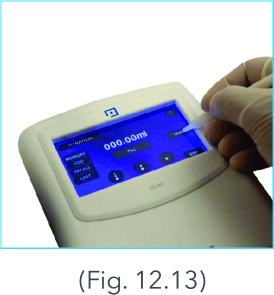
Sensitive Media

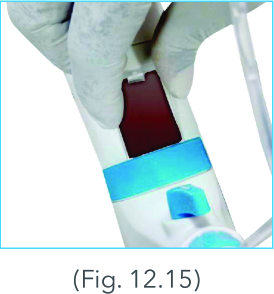
For light-sensitive media (e.g., Iodine, Potassium Permanganate and Silver Nitrate solutions), we recommend the use of ‘Amber Coloured Windows’ or the inspection windows provided in the box.

1. To replace the inspection window, unclip the default inspection window by pressing it from its top and
then removing it.
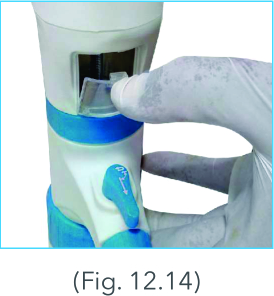
2. Place the Amber Coloured Window in the slot provided at the bottom of the housing and press it down until you hear a click sound.
13. Data Transfer Setup

Connecting the USB Mini Cable:

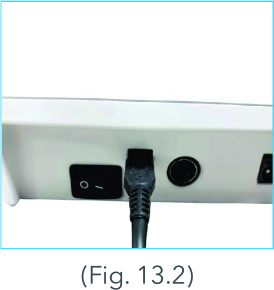
1. Connect the Mini USB cable from the control panel to your PC/Laptop for transferring and storing the control panel’s data on the latter.
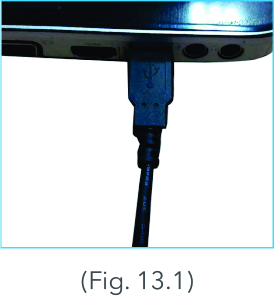
2. Insert the wider end of the USB cable in the USB port of the PC/Laptop and the smaller end at the back of the control panel.
Software Initialization

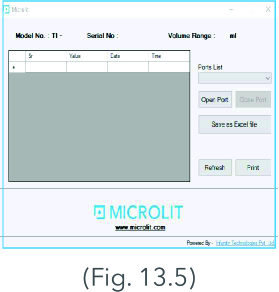
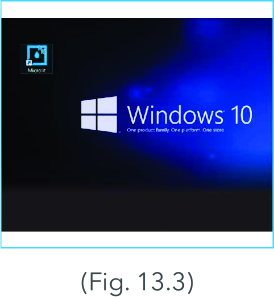
3. Double click on the Microlit Communication icon to run the software.
4. From the Ports List button, select the port from the drop down menu.
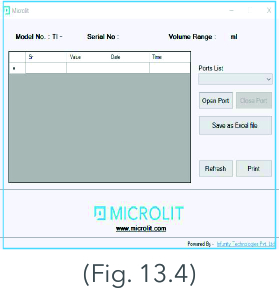
5. Click on OPEN PORT.

6. The window will capture the model number, serial number and the volume range of the E-BURETTE.
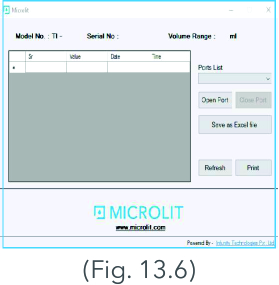
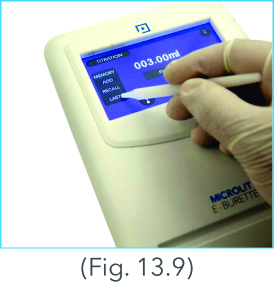
7. Click ADD from the control panel to save the readings from the control panel to the PC/Laptop
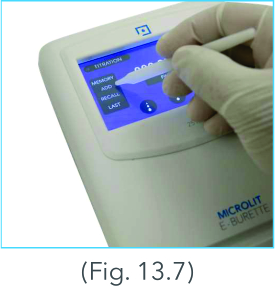
Note: The ADD button shall blink and the data shall be transferred to the PC/Laptop.

8. The readings will also be saved in the internal memory. Please note that all fields are captured in the file.

Memory

1. Click ADD from the control panel to save the readings from the control panel to the internal memory.

2. To recall the previous recorded reading (s), press the RECALL button.
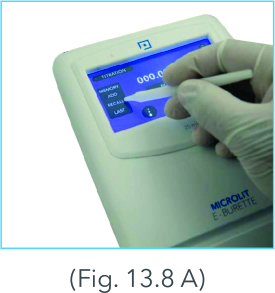
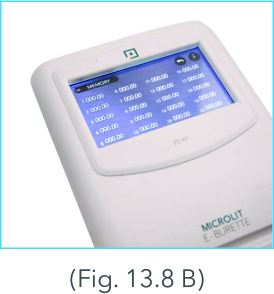
Please note that the recall grid displays the last 20 recorded readings. The LAST saved reading will be displayed on the number 1 position of the table.
3. For quick recall of the last reading, press the LAST button. Please note that the last saved readings will be displayed till the time LAST button is pressed.
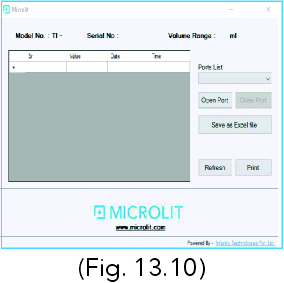
Creating a File Name

1. Select the port from the port list dropdown menu.
2. Click Open port.
3. The Software captures the Model No., Sr. no. and volume range.
4. After transferring the data from control panel to the software window we can save the file by clicking the
“Save as Excel File”.
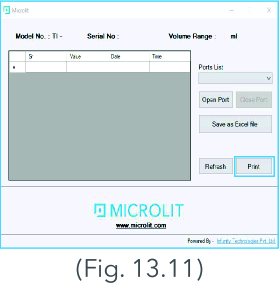
Printing the data

The data recorded while operating the E-BURETTE can be printed directly from the software by clicking
the PRINT tab. For this, select the printer and print the readings. You can also access the saved .xls file to print.
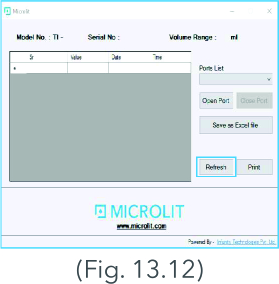
Refresh

To start afresh for new readings on the software, click on the REFRESH tab. The readings on the grid shall be deleted and new readings can now be transferred in it.
Exit

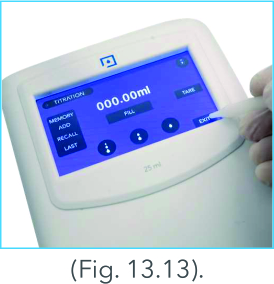
1.  To end working with the E-BURETTE, press the Exit button. The panel will warn the user to turn the
knob in the re-circulation mode.

2.  Click on the tick ( ) button to proceed. The piston will empty the barrel and go to the home position.

3.  Press the ON/OFF button to switch OFF the control panel.
14. Error Limits

The error limits (Accuracy and Coefficient of Variation) mentioned in Product Specifications (Page 1) are in accordance with the nominal capacity (or maximum volume) indicated on the instrument. These are obtained by using the instrument with distilled water at equilibrium, ambient temperature of 20 °C, while operating the device smoothly and steadily. The error limits are well within the limits of DIN EN ISO 8655-3.

Capacity
(ml)
Increment
(ml)
Accuracy
(± %)
Accuracy
(±ml)
CV
(± %)
CV
(±ml)
10 0.005 0.1 0.01 0.1 0.01
25 0.01 0.07 0.0175 0.05 0.0125
50 0.01 0.05 0.025 0.05 0.025


15. Calibration

User Calibration Procedure
The E-BURETTE has been laboratory calibrated at its nominal volume. However, due to changes in environmental conditions and the viscosity of the media which is dispensed, we recommend gravimetric testing
every 3-12 months. Gravimetric volume testing according to DIN EN ISO 8655-6 is performed as follows:

1.  Click the settings icon on the bottom right of the Home Screen.
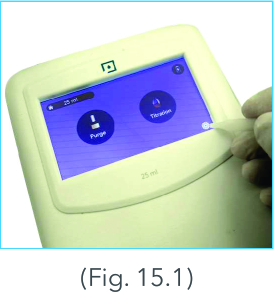
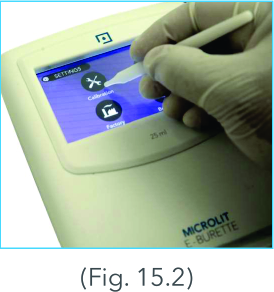
2.  From the settings menu, choose Calibration.
3.  Fill the nominal volume of double distilled de-ionized water by clicking the FILL button on the calibration screen of the operating panel.
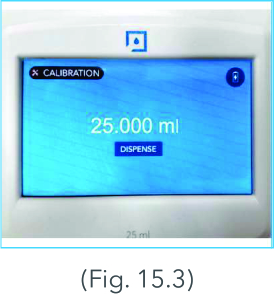
4.  Dispense the filled liquid by clicking on the DISPENSE button on the calibration screen of the control panel.
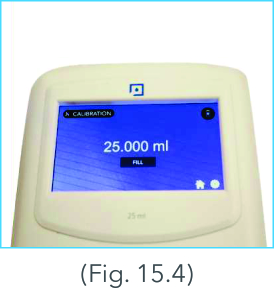
5. Measure the dispensed liquid on a balance and enter the value in mg using the provided electronic keyboard. Click the tick mark to proceed.
Note: CAL label will start appearing on top of all screens.

6. Repeat this procedure until the nominal volume is achieved on the electronic balance.

Factory Reset

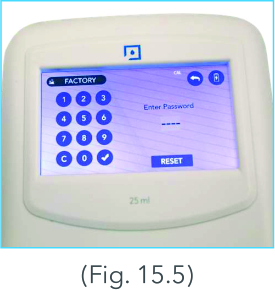
The factory reset is for the MICROLIT factory settings which is password protected and intended to be used at the manufacturing facility. (Fig. 15.5) If the reset button is pressed, the user calibrated settings
shall be reset with the default factory settings & the CAL label will disappear from the screens.
16. Other Settings

Control panel brightness setting
User can change brightness from setting screen on the control panel.

1. Click on the settings icon from the home screen.
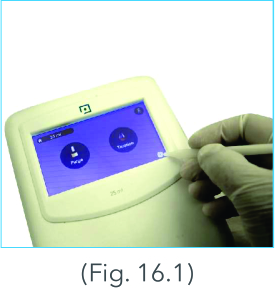
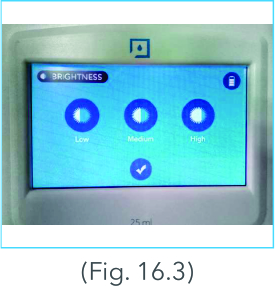
2. In the settings windows, click the BRIGHTNESS icon.

3. From the BRIGHTNESS window, select the level of brightness and tick mark to save it.
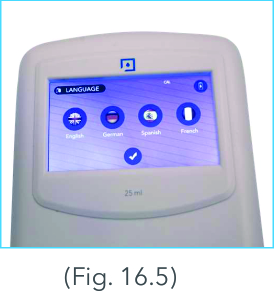
Language Settings
User can select the preferred language from the language settings.

4. Click on the settings icon from the home screen.
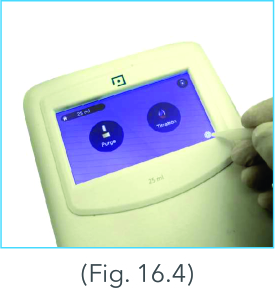
5. Select the preferred language from the tab by clicking on it and tick mark ( ) to save it.
MICROLIT E-BURETTE supports four languages – English, German, Spanish and French.
17. Cleaning and Product Maintenance

Whenever cleaning is required, run the burette under distilled water. Fill the barrel completely with distilled water and press the fast dispense button to dispense the water completely.
Procedure to Disassemble the Delivery Pipe:

Unscrew the chuck nut by rotating it in anticlockwise direction and pull out the delivery pipe. Clean the delivery pipe with de-ionized water.
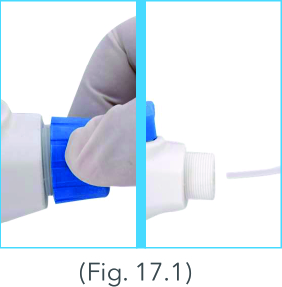
Procedure to Assemble the Delivery Pipe:

1.  First push the delivery pipe into the lower housing till it stops going in further.
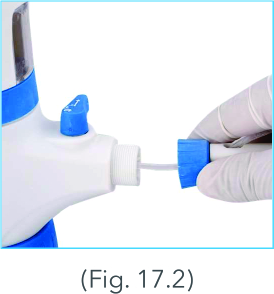
2. Screw the chuck nut to complete the assembly by turning it in clockwise direction.

Note: Use rubbing alcohol on a cloth or cotton to clean the external body
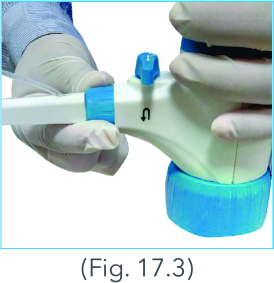
18. Troubleshooting

Problem Possible Causes Solution
Piston difficult to move Formation of crystals or
deposition of dirt
Perform a cleaning cycle
Filling not possible Filling valve stuck – Clean the filling valve.
– If the valve ball is stuck, use a 200 µl plastic tip to loosen it
Air bubbles in the instrument – Purging not complete
– Filling tube loose or damaged
– Filling tube does not dip into the liquid
– Purge the instrument again.
– Fasten the telescopic filling tube firmly. If necessary, cut the tube off by approx. 1 cm from the top or replace it.
– Fill up the bottle, or correctly adjust the length of the telescopic filling tube.
The volume delivered is smaller than that indicated The instrument has not been completely primed Prime the instrument again.
The instrument doesn’t indicate any function Internal error Perform a restart

19. Return for repair

1.  Clean and decontaminate the instrument carefully.

2.  Always mention the exact description of the type of malfunction and the media used. Please note that if information regarding media used is missing, the instrument cannot be repaired.

3.  Shipment is at the risk and the cost of the sender.

20. Calibration Guidelines

ISO 9001 and GLP-guidelines require regular examinations of your volumetric instruments. We recommend checking the volume every 3-12 months. The interval depends on the specific requirements of the
instrument. For instruments frequently used or in use with aggressive media, the interval should be shorter.

21. Warranty

MICROLIT shall not be liable for the consequences of improper handling, use, servicing, operation or unauthorized repairs of the instrument or the consequences of normal wear and tear, especially of wearing parts such as pistons, seals, valves and the breakage of glass as well as the failure to follow the instructions of the operating manual. We are not liable for damage resulting from any actions not described in the operating manual or non-original spare parts or components being used.

22. Disposal

  •  The adjoining symbol means that storage batteries and electronic devices must be disposed of separately from household trash (mixed municipal waste) at the end of their service life.
  • According to the Directive 2002/96/EC of the European Parliament and of the Council on Waste Electrical and Electronic Equipment (WEEE) published on 27 January 2003, electronic equipment requires disposal according to the relevant national disposal regulations.
  • Batteries contain substances that can have harmful effects on the environment and human health. Therefore, according to the Directive 2006/66/EC of the European Parliament and the Council on Waste Batteries of 6 September, 2006, batteries require disposal according to the relevant national disposal regulations. Dispose the batteries only when they are completely discharged. Do not short-circuit the battery to discharge it. Subject to technical modifications without notice. Errors accepted.

To know more about Microlit Burette, please visit the product page https://www.microlit.us/product-category/burette/.
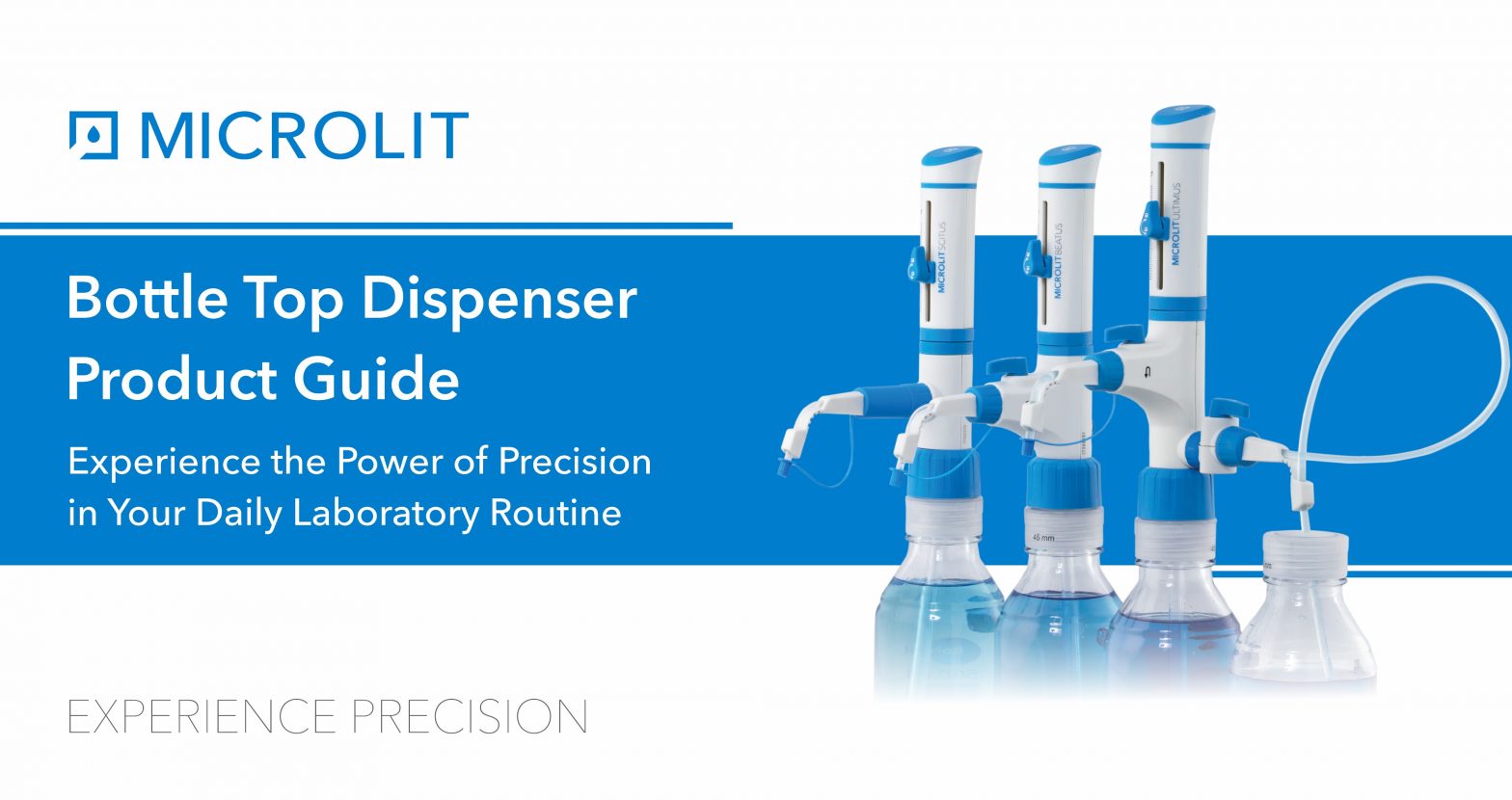
Bottle Top Dispenser Product Guide

What is a bottle top dispenser?

A bottle top dispenser is a common lab instrument which is used to dispense precise amounts of chemicals/ reagents, organic and inorganic solvents, oils etc. from bottles or other containers. The process of dispensing manually poses several risks such as spilling of chemicals, inaccurate measurements and even fatal lab accidents. In order to prevent such hazards and enhance lab safety, Bottle Top Dispensers are the go-to instruments for dispensing reagents safely and precisely in a laboratory environment.

Bottle top dispensers can safely dispense a fixed amount of liquid usually between 1ml and 100 ml, directly from a bottle to a receiving container. Bottle top dispensers help reduce the loss of reagents, saves time and increases work efficiency. Along with facilitating routine lab tasks, bottle top dispensers also improve productivity by speeding up the entire laboratory experimentation process.

Components of a Bottle Top Dispenser:

Bottle top dispensers  provide a closed environment for chemical dispensing preventing accidental spilling and reducing the risk of exposing users to hazardous chemicals. Bottle top dispensers are generally provided with a set of adapters which allow them to comfortably fit on bottles of varied neck sizes. Using a suitable adapter, a bottle top dispenser can be made to fit different sized laboratory bottles. The basic components of bottle top dispensers are listed below:

Piston:

The heart of the bottle top dispenser is a piston which creates the required vacuum in the barrel to be able to aspirate and dispense liquids precisely. By an upward movement of the piston, the preset amount of liquid draws up into the dispenser cylinder. Consequently, the downward movement of the piston enables the release of the liquid into the container via a dispensing valve. Since the piston comes in direct contact with the liquid or chemical to be dispensed, it is important that the piston material should be chemically inert to most of the reagents.

Glass Barrel:

Glass Barrel is used to hold the desired amount of reagent inside the instrument. When the piston is pulled upward, the liquid is plated into the glass barrel and when the piston is pushed down the liquid exits through the discharge tube. A polypropylene cover protects the glass barrel and prevents the glass from splattering in case of any accidental breakage.

Volume Adjustment Knob:

The volume adjustment knob is used to set the target volume which the user wants to be dispensed using the bottle top dispenser. It has a pointer which points to the volume scale printed on the bottle top dispenser housing. The volume can be set by releasing the lock by rotating the knob 180 degrees anticlockwise, moving it to the desired position and locking it by rotating it 180 degrees clockwise. 

Dispensing Nozzle:

This component is used to dispense the liquid safely in the receiving vessel. The dispensing nozzle is flexible in the case of Microlit bottle top dispensers to easily direct the flow of liquid.

Nozzle Cap:

The nozzle cap prevents any unwanted drops at the workplace and avoids contact with hazardous chemicals.

Inlet Tube: 

Inlet tubes are used to draw up liquid from the reagent bottle. The tube is telescopic in nature and length of the inlet tube can be adjusted according to a variety of reagent bottle sizes.

Bottle adapter:

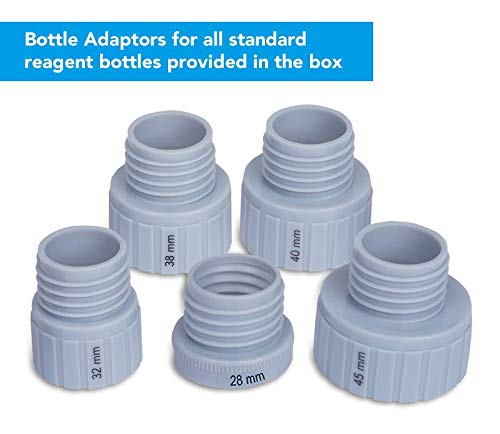
Bottle adapters are used to mount the bottle top dispensers on the reagent bottles of varied necks sizes. Microlit Bottle Top Dispensers are provided with a set of 5 adapters: 28 mm, 32 mm, 38 mm, 40 mm and 45 mm which allow the dispensers to be used with almost all the laboratory reagent bottles.

Bottle Adaptors

Types of Bottle Top Dispensers:

Bottle top dispensers can be classified depending upon:

1.  Piston Mechanism:

  • Bottle top dispenser with floating piston:

This type of bottle top dispenser does not require any piston seal which makes it very durable and maintenance friendly. The piston fits into the dispensing cylinder without contact with any surface. The piston and cylinder are separated by a slight gap (around 1 millimeter) which is filled with the liquid. This slight film of liquid acts as a lubricant for the piston which helps it to glide very easily while dispensing.

  • Bottle Top Dispenser with wiping-seal piston:

This type of bottle top dispenser comes with a wiping-seal in addition to the floating piston mechanism. Due to this, the system requires higher operating force during liquid delivery which can lead to faulty sealing due to friction wear.

2.  Chemical compatibility of the instrument:

  • Bottle top dispenser for highly corrosive acids

The traditional bottle top dispensers with glass barrels cannot be used to dispense highly corrosive chemicals like the Hydrofluoric Acid (HF) and other high-purity media as these may erode the inner surface of the equipment, forming cracks and leading to serious accidents. Thus, a high precision liquid handling instrument engineered with carefully selected and tested materials for use with Hydrofluoric Acid (HF) should be used in this case. MICROLIT LENTUS™ is one such instrument.

The components of the liquid path are carefully chosen so that they do not react/get corroded while getting in contact with the highly corrosive acids. 

  • Bottle top dispenser for acids, bases and solvents :

Thesebottle top dispensers have a glass barrel, PFA coated or PTFE piston which makes the dispensers compatible with most of the acids, bases and solvents.  Such dispensers have two valves with glass balls.

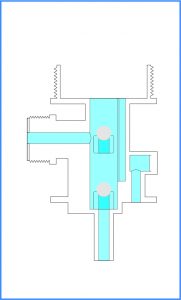
Inlet Valve: This valve is vertical. It operates under gravity and does not require a spring to hold the glass ball in its position, in order to keep the valve closed.

Outlet Valve: This valve is horizontal. It requires a spring to keep the glass ball in its position, in order to keep the valve closed while aspirating reagents in the barrel. It opens only when a reagent is being dispensed.

The spring housed in the outlet valve, poses problems of spring metal reactivity and chemical deposition.

Hence, Microlit dispensers break the norm by having both inlet and outlet valves in the vertical position. This enables us to eliminate the spring from the valve system as no force is required to keep the ball in its default state

Microlit offers the most innovative bottle top dispensers equipped with the award winning SpringlessValve™ technology. The Springless Valve™ technology makes these dispensers universal and compatible with both organic and inorganic solvents.

Size and Range / Technical Specifications:

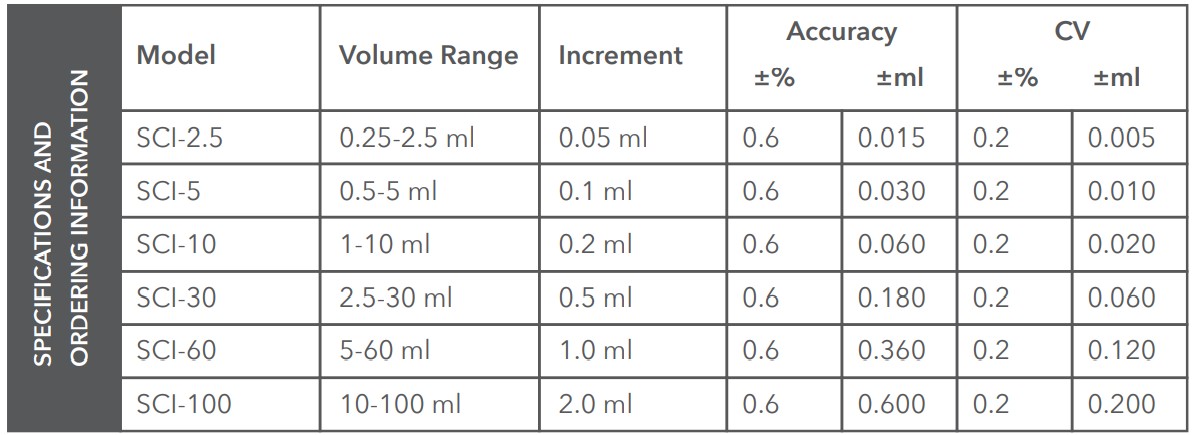
Bottle Top dispensers are available in different volumes ranging from 0.25ml to 100ml. The commonly used variants of bottle top dispensers are listed below along with their permissible error limits as specified in the DIN EN ISO 8655-5.

Volume Range Increment Accuracy
CV
+% +ml +% +ml
0.25-2.5 ml 0.05 ml 0.5 0.0125 0.2 0.005
0.50-5 ml 0.1 ml 0.5 0.025 0.2 0.01
1-10 ml 0.2 ml 0.5 0.05 0.1 0.01
2.5-30 ml 0.5 ml 0.5 0.15 0.1 0.03
5-60 ml 1.0 ml 0.5 0.3 0.1 0.06
10-100 ml 2.0 ml 0.5 0.5 0.1 0.1


How to operate a Bottle Top Dispenser?

It is quite simple to operate any bottle top dispenser. However, proper setup instructions must be followed to avoid risk of spillage or other accidents in the laboratory:

1.  Checking the calibration report:

  • Start by checking the calibration report generated for the bottle top dispenser.
  • The report must indicate that the dispenser is calibrated at an ISO 17025 certified laboratory.
  • You may estimate the performance of the instrument by examining error limits mentioned on the calibration report.

2.  Choosing the right adapter:

  • A set of bottle adapters are provided with the instrument to help mount the dispenser on standard reagent bottles. 
  • Adaptors are usually made with polypropylene (PP) to avoid reactivity with most chemicals. ETFE/PTFE adaptors may be used for aggressive acids and solvents.
  • Choosing the correct adaptor according to the neck size of your reagent bottle.
  • The adapter comes in different sizes which are 28mm, 32mm, 38mm, 40mm and 45mm.

3.  Attaching the inlet tube or extension

The telescoping tube can be adjusted according to the bottle size (height) and then fixed at the bottom of the bottle top dispenser. 

4.  Mounting the dispenser on the reagent bottle

After attaching the inlet tube to the dispenser, mount it on the reagent bottle and screw the dispenser tightly onto the bottle.

5.  Purging the Dispenser

It is important to remove air bubbles from the dispenser dispenser barrel as these may cause inaccuracy in dispensing of the liquid. To do so:

  • Turn on the recirculation knob by rotating it 90 degree anti-clockwise (This feature is only available in BEATUS and ULTIMUS bottle top dispensers)
  • Aspirate and dispense a few times until this barrel is bubble-free
  • Turn off the recirculation knob by rotating it clockwise towards the dispensing nozzle
  • Aspirate and dispense to ensure bubble-free dispensing

6.  Setting the right volume

  • To begin dispensing, the user must determine the quantity (in ml) that is required for the experiment.
  • EasyKnobTM is a specially designed volume adjustment knob that is available in all Microlit bottle top dispensers. It allows 180° rotation for locking and unlocking which results in simple and accurate volume adjustment.

7.  Dispensing

Wear protective clothing, protective gear for the eyes and hands. To avoid splashes, dispensing must be done slowly.

Follow all the safety instructions and observe limitations of use and operating constraints.

  • Remove cap from the discharge tube.
  • Set the volume of liquid to be dispensed using the volume adjustment knob.
  • Turn the valve to ‘Dispensing’.
  • Gently lift the piston until the upper end. Press the piston downwards slowly and steadily with minimal force until it reaches the bottom and all the liquid in the barrel is dispensed.
  • Wipe off the discharge tube against the inner wall of the receiving vessel.

Cleaning, maintenance and storage of a Bottle top dispenser

1.  Cleaning  based on usage

The instrument must be cleaned immediately in the following situations:

  • The piston is hard to move
  • The reagent to be dispensed in being changed
  • After a long period of non usage
  • Before sending for maintenance and repair work
  • Before sterilization 
  • Regularly when using crystallizing liquids

2.  Standard cleaning

Before beginning the cleaning process, the lab technician must wear protective glasses, clothing, and gloves. 

  • Dispense all liquid from the barrel – there should be no liquid before starting the cleaning process
  • Place the instrument together with the bottle in an empty sink
  • Unscrew the instrument and separate it from the bottle. The inlet tube is no longer immersed in the liquid
  • Carefully tap the inlet tube against the inside of the reservoir until the reagent has completely drained out of the inlet tube
  • Hold the dispensing nozzle over the reservoir’s aperture and apply piston stroke gently in order to return any contents into the reservoir.
  • Empty the instrument completely 
  • You may then dispense distilled water through the system to clean it
  • If the piston barrel is still not cleaned, you may need to dissemble the instrument and repeat the cleaning process again. Never use force to disassemble and reassemble the instrument. It may cause physical damage to the instrument.

3.  Intensive Cleaning

Intensive cleaning must be done if the reagent is dense and viscous. It requires complete disassembling of the instrument so that all the parts can be cleaned separately. Before disassembling the instrument for intensive cleaning,  do not forget to carry out standard cleaning procedures. 

  • Pull the cap outwards to expose the calibration nut and unscrew it with the help of a calibration tool to disassemble the piston.
  • Pull out the shaft and rinse together with deionized water. 
  • Clean the cylinder with a bottle-brush. Carefully remove deposits at the edge of the glass cylinder.
  • Flush all the parts such as delivery nozzle, pipe and cover etc. of the instrument with deionized water. Use soft brushes and a suitable cleaning agent to clean the instrument where needed.

Storage

It is important to store the bottle top dispenser properly for long-term applicability. The bottle top dispenser and all its accessories should be stored in a clean, cool and dry place. The temperature of the storage space should be from -20% C to 50 ° C (-4 ° F to 120 ° F), with relative humidity between 5% and 95%.

How to choose the right bottle top dispenser?

The bottle top dispenser is a widely used scientific tool to dispense chemical reagent precisely. Generally choosing a bottle top dispenser depends on the amount of liquid and its types. However, there are other factors to consider when choosing a right bottle top dispenser for the laboratory.

1.  Chemical Compatibility:

When selecting a bottle top dispenser, the user should check the chemical compatibility of the dispenser with the reagent to be dispensed. Some manufacturers offer different bottle top dispenser models for different types of reagents – organics, inorganics, solvents etc. However, Microlit dispenser, with its unique SpringlessValve™ system is a universal dispenser for all types of reagents. All manufacturers offer a chemical compatibility chart with their dispensers. This includes all the commonly used reagents and their compatibility with the materials used in the construction of the dispenser. Please be sure to check this compatibility chart before making a purchase. The chemical compatibility for Microlit dispensers can be found here –  https://www.microlit.us/wp-content/uploads/2019/01/chemical-compatibility-chart-Jan-2020-2-2.pdf

The commonly used reagents with bottle top dispensers can be categorized as follows: 

  • Acids: Examples include Acetic Acid, Hydrochloric Acid, Sulfuric Acid, and Nitric acid
  • Bases: Examples include Acetyl chloride, Ammonia, Pyridine and sodium hydroxide
  • Organic Reagents: Examples include Toluene, Methanol, Trichloro trifluoroethane and Dichloromethane.
  • Highly Corrosive Acids: Hydrofluoric Acid

Note that Microlit offers a special bottle top dispenser Microlit LENTUS for use with highly corrosive acids. The materials used in this dispenser ensure that it is not affected by direct contact with corrosive acids.

2.  Viscosity of the reagent:

If you need do dispense viscous liquids such as Essential Oils, Botanical Extracts, Grain Alcohol and Vegetable Glycerine, the applicable viscosity range for the dispenser needs to be considered.:

Highly viscous liquids with a kinematic viscosity of between 75 to 500mm2/second will require careful selection while reagents having kinematic viscosity below 75 mm2/second can be used with any kind of bottle top dispenser efficiently. 

3.  Capacity of the dispenser:

Bottle top dispenser comes in both fixed volume and adjustable volume models with specific range of liquid quantity. The volume can be adjusted either manually with the help of a knob or dialed electronically through a control panel. So it is necessary to make sure that your selected bottle top dispensers are able to dispense the amount of liquid that is frequently required for your experiments. Note that dispensers with lower capacity offer higher accuracy and precision. So, if you want to dispense 10ml, a 1-10ml dispenser is recommended over a 2.5-30ml dispenser to ensure more accurate results. 

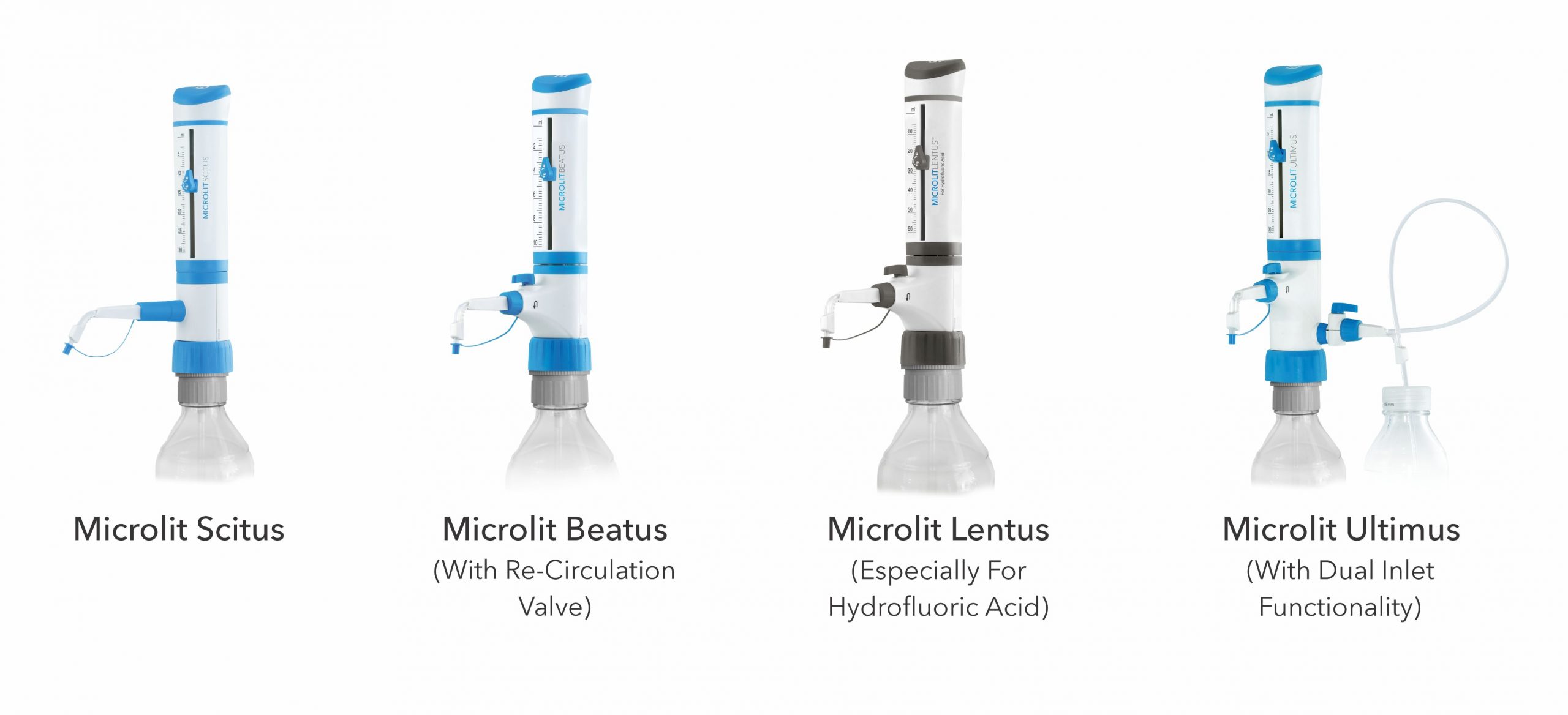
The Microlit Bottle Top Dispensers – Ultimus, Beatus, Scitus & Lentus™  – are also available in variable volumes.

S.No. Microlit Ultimus Microlit Beatus Microlit Scitus Microlit Lentus™
1 0.25 – 2.5 ml 0.25 – 2.5 ml 0.25 – 2.5 ml 0.25 – 2.5 ml
2 0.5 – 5 ml 0.5 – 5 ml 0.5 – 5 ml 0.5 – 5 ml
3 1 – 10 ml 1 – 10 ml 1 – 10 ml 1 – 10 ml
4 2.5 – 30 ml 2.5 – 30 ml 2.5 – 30 ml 2.5 – 30 ml
5 5 – 60 ml 5 – 60 ml 5 – 60 ml 5 – 60 ml
6 10 – 100 ml 10 – 100 ml 10 – 100 ml


How is a bottle top dispenser calibrated?

Each bottle top dispenser is individually calibrated in an ISO 17025 certified laboratory and comes with a calibration certificate. However, if environmental conditions and the viscosity of the liquid being used changes drastically, re-calibration is recommended to achieve high accuracy.

To re-calibrate the instrument, the below steps need to be followed:

  • Set the bottle top dispenser at 50% of the nominal volume (capacity).
  • Follow the common rules for calibration used in statistical quality control (ISO 8655/2).
  • Set the volume and dispense five volumes of distilled water at 20°C temperature on electronic balance to establish the actual mean volume of liquid dispensed.
  • If the calculated average mean varies from the preset volume at the dispenser, re-calibration is required again.
  • For re-calibration of the dispenser, pull the cap outwards to expose the calibration nut. Using the calibration tool, turn the nut clockwise to reduce the volume or anticlockwise to increase the volume and repeat the calibration procedure again to achieve the desired volume result.

How to sterilize a bottle top dispenser?

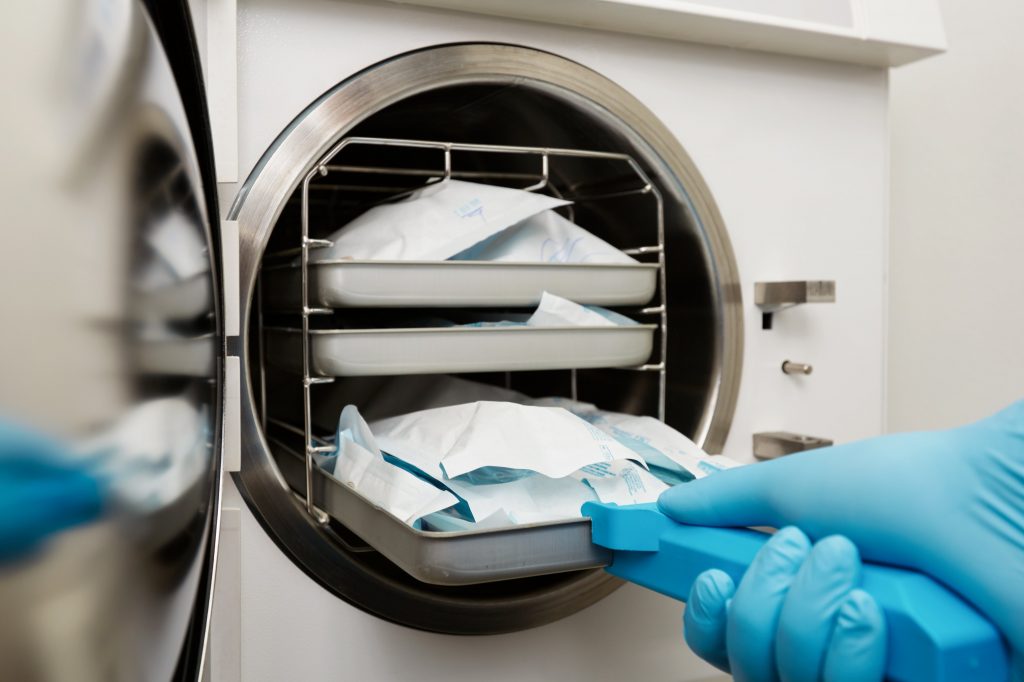
The dispenser can be autoclaved at 121°C (or 250°F) and 1 bar absolute (15 psi) with a holding time of at least 15 minutes.

autoclaving

It is recommended to autoclave the instrument after disassembling for deep sterilization.

  • First carry out standard cleaning of the instrument.
  • Pull the cap outwards to expose the calibration and unscrew with the help of a calibration tool to disassemble the piston and shaft from the main housing.
  • After unscrewing, pull out the shaft. 
  • Now autoclave both the assemblies at 121°C and 15 psi pressure for 15-20 minutes. Remember that the volume adjustment knob should always be kept in the unlocked position while the autoclaving process.
  • Now remove the instrument and its parts from the autoclaving machine and cool it at room temperature for at least 2 hours before use.
  • Reassemble the parts again. It is necessary to recalibrate the instrument after every autoclaving process for accurate dispensing.

When is bottle top dispenser calibration required?

Calibration is an important part of any laboratory practice. Like the other precision instruments, bottle top dispensers also need to be calibrated to maintain the reliability and accuracy of readings. 

Normally the calibration process needs to be performed every 6-12 months depending upon the frequency of use of the dispenser. 

However, there are other special cases where recalibration is required:

  1. Post autoclaving process
  2. Post repair or maintenance services
  3. Significantly changing the viscosity of the reagent to be dispensed
  4. Long period of non-usage

Applications of Bottle Top Dispensers

Bottle top dispensers are widely used in the fields of biology, chemistry, clinical medicine, industrial laboratories etc. due to the accurate and precise dispensing of liquids, enhanced safety, ease of use and convenience. Here are some common industries where bottle top dispensers are playing vital role in the sample preparation process:

  1. Pharmaceutical
  2. Healthcare
  3. Food and Beverages
  4. Environmental Monitoring
  5. Academic & Research Institutes
  6. Life Science

Benefits of using a Bottle Top Dispenser

Bottle top dispenser is a common yet essential laboratory instrument for liquid dispensing. Some of the benefits of bottle top dispenser are:

  1. Bottle Top Dispensers  help to dispense  highly corrosive acids such as the Hydrofluoric Acid safely and accurately. Mis-handling of such chemicals can put your health and skin at risk.
  2. Bottle top dispensers make the reagent movement hassle-free. They eliminate the risk of splashing of the reagent while dispensing.
  3. With the high precision technology, bottle top dispensers can easily transfer small quantities of liquids very accurately. The accuracy of the dispenser depends on the variety of bottle top dispenser which can be within ±0.5% – ±0.6% tolerance as per ISO 8655 dispensing standard.
  4. Some dispensers come with the recirculation valve technology which helps in reducing the wastage of liquid during the purging process and avoid spillage of chemicals during storage.
  5. Along with facilitating complex lab tasks, Bottle Top Dispensers also improve productivity by speeding up the experimentation process.

Why are Microlit Bottle Top Dispensers the best choice for your lab?

A bottle top dispenser is an innovative scientific instrument popularly used in many research institutes, biotechnology labs, wineries, food & beverage industries and other similar industries. Bottle Top Dispensers eliminate the risks of spillage and wastage of chemical reagents. Sometimes, choosing the right bottle top becomes a  difficult task as many bottle top dispensers are available in the market with their limited dispensing features.

Some of the key features present in Microlit Bottle Top Dispensers are given below:

Microlit Bottle Top Dispensers

Feature exclusive to Microlit Ultimus:

Dual Inlet™ Technology is an award-winning technology patented in India, the EU and the US. Microlit Ultimus with dual inlet technology is a state-of-the-art bottle top dispenser. It offers 4 liquid handling modes – rinsing, dilution, bottle refilling and dual liquid handling in a single unit without dismounting the instrument from the reagent bottle.

Feature exclusive to Microlit Lentus™:

Microlit Lentus™ is made using chemically-inert materials and a high purity ceramic valve system which ensures safe and accurate dispensing of the Hydrofluoric Acid and High Purity Media.

Feature exclusive to Microlit Beatus & Microlit Lentus™:

Recirculation valve prevents the loss of reagents during purging so that they can be re-directed into the mounted bottle and facilitate bubble-free dispensing.

Features common across all Microlit Bottle Top Dispensers – Ultimus, Beatus, Scitus & Lentus™

  • SpringlessValve™ facilitates smooth & jam-free dispensing.
  • EasyKnob™ is a specially designed volume adjustment knob that allows 180° rotation for easy & effortless volume setting.

FlexiNozzle™ is an adjustable delivery nozzle. It offers a high level of flexibility, facilitating easy dispensing in demanding laboratory conditions.

Troubleshooting:


Issue Possible Root Cause Solution
Piston Jam
  • Formation of crystals
  • Dirt accumulation
  • Piston Damaged
  • Immediately stop dispensing. Do not try to give extra force for dispensing
  • carefully follow the cleaning procedure.
Dispensing issue/ No reagent is aspirated
  • Dispensing nozzle is blocked
  • Adjusted to minimum volume setting
  • Filling valve clogged/ sticking
  • Use volume setting knob to set higher volume
  • Follow the cleaning procedure
  • Disassemble the dispensing nozzle and flush thoroughly with distilled water
Air bubbles in aspirated liquid
  • Instrument is not properly primed
  • Filling tube is not attached correctly or damaged
  • Reagent has been aspirated too quickly
  • Liquid reservoir is empty
  • The filling action is too fast
  • The piston is leaking
  • Draw the reagent slowly
  • Prime the instrument
  • Push the filling tube firmly. If necessary, cut off approx. 1cm of the tube at the upper end and then reconnect it or replace it
  • Follow the cleaning procedure
  • Raise the piston slower when aspirated
  • Fill the empty reservoir
Wrong dispensing volume
  • The instrument is not calibrated
  • Follow the calibration steps
Barrel does not fill with reagent
  • Inlet tube is not fitted firmly
  • Reconnect inlet tube correctly.
Filling is not possible
  • Adjust volume to minimum setting
  • Set to the required volume
Leakage
  • Recirculation valve is not connected
  • Adapter is not properly mounted
  • Check the recirculation valve
  • Check if the adapter is mounted properly


FAQs:

How do I remove small air bubbles from the barrel?

To remove the air bubbles from the barrel, purging or priming needs to be performed. For priming, gently pull the piston up and then push down till the piston hits the base. Repeat the steps 4-5 times. 

Can a bottle top dispenser be autoclaved?

Yes, autoclaving is important to sterilize the bottle top dispenser. Autoclaving can be done at 121° C, 15PSI. for 15-20 mins. Before autoclaving, instruments should be disassembled properly and the volume knob must be kept in an unlocked position.

How should I clean the dispenser?

It is recommended to rinse the dispenser with deionized or distilled water before and after the use. For sensitive or sticky reagent, intensive cleaning is required. For details, please check the cleaning and maintenance section above.

Is an adapter necessary for a bottle top dispenser?

Yes, an adapter is necessary if you want to use a bottle top dispenser with any kind of bottle. Mostly bottle top dispenser comes with different standard size adapters which fit to maximum standard size bottle neck. 

Is the telescopic tube extendable?

Telescopic tubes can be extended as per the reagent bottle. For the minimum and maximum limit of the telescopic tube, you can see the instruction manual provided with the bottle top dispenser.

Can bottle top dispensers be used for any kind of liquid?

It depends on the liquid and the bottle top dispenser limitation. Mostly bottle top dispensers can be used efficiently with liquids which have kinematic viscosity less than 75 mm2/second.  For highly aggressive chemicals like the Hydrofluoric Acid, a special bottle top dispenser is required for proper dispensing. Check the chemical compatibility chart before dispensing such liquids. 

What is the function of the recirculation valve?

The recirculation valve allows to purge or prime the dispenser without wasting the reagents. Before the first use, the dispenser needs to be primed to remove air bubbles. With a recirculation valve, the reagent is not wasted during priming. 

Bottle top dispenser is drawing up bubbles and liquid. What should i do?

There is an air leak somewhere in your dispenser. This may be due to the filling and discharging valves. Check whether the filling and discharge valves are tight. Also, the cylinder may crack or loosen from the valve block if the dispenser is accidentally dropped.

Does the dispenser come with the bottle?

No, Bottle Top Dispenser does not come with the bottle. The dispenser is designed to fit with adapters which can be fitted on reagent bottles of varied neck sizes. Microlit bottle top dispenser comes with five adapters such as 28mm, 32mm, 38mm, 40mm and 45mm. Choose the bottle adapter according to the reagent bottle and mount it with your dispenser to dispense properly.

What are the autoclaving (sterilization) parameters?

By standard, the instrument should be autoclaved at 121 ° C with 15psi for 15–20 mins. It is recommended to disassemble the equipment prior to steam sterilization for proper cleaning. All microlit dispensers come with the autoclaving feature to improve the safety of technician and testing results.

What do “Instrument Calibration”, “Gravimetric testing”, and “Volume Adjustment” mean?

Instrument calibration actually refers to the task of measuring the results from an instrument and determining its accuracy and precision. 

Gravimetric testing is one of the methods of performing calibration. This usually means repeated weighing of dispensed water of distilled water. Distilled water has a defined density at specific temperature and atmospheric pressure. By finding the mass of water, it is possible to find the actual volume, and from that, determine the accuracy and precision of the instrument.

Volumetric adjustment is the physical change in the instrument which was calibrated.

Can temperature make a big difference in gravimetric testing?

Yes, it can. Calibration should be done in an ideal room temperature as per standard. When calibration is performed, temperature should be recorded with a thermometer having an error tolerance of max 0.2°C.

To know more about Microlit Bottle Top Dispensers, please visit the Microlit product page Bottle Top Dispensers.

Top 10 Scientific Research Institutes in the US

Research & Development in the United States (US) is funded and performed by top research universities & institutes in the US, along with the federal government, state governments, businesses, academia, and non-profit organizations. With the contributions from these sectors, the US emerged as the global leader in R&D in the 20th century, funding 69% of annual global research efforts.

Investment in R&D

Over the years, R&D investment has only grown in the country. Medical and health R&D spending in the US grew by 6.4%, reaching $194.2 billion from 2017 to 2018. Additionally, in 2018, US businesses reported $441 billion for R&D performance, a 102% increase from 2017. Of the $441 billion that companies spent on research, $29 billion was spent on basic research, $65 billion on applied research, and $347 billion on development.

The US also maintains its position as the most prolific publisher of high-quality natural-sciences research in the Nature Index with a share of 20,152.48. It further continues to be bolstered by its top-performing institutes, such as Harvard University, Stanford University, Massachusetts Institute of Technology (MIT), and National Institutes of Health (NIH), all of which are considered some of the top & largest medical research institutes in USA.

Fostering Scientific Research

R&D investment in the US only continues to grow with The Association of Public and Land-grant Universities and the Science Coalition’s introduction of a bipartisan bill in the United States Congress that would expand the budget of the National Science Foundation by $100 billion over the next five years. This investment would help the country to increase research in areas like machine learning, artificial intelligence, robotics, and advanced manufacturing, providing research opportunities at universities and support for undergraduate programs and research.

Additionally, the US National Science Foundation has funded 801 grants over $111 million in response to the COVID-19 situation. NSF-funded research has played an imperative role by exploring the science & engineering behind pertinent diagnostic tools and medical devices to discovering novel solutions that help businesses, individuals, and communities to tackle the challenges of these testing times.

Let us delve deeper and take a look at the top 10 institutes in the country spearheading scientific research.

1.  US Department of Health and Human Services/ National Institutes of Health (NIH)

US Department of Health and Human Services

(Shown Above: NIH, Source: Flickr)

The National Institutes of Health (NIH) is a part of the US Department of Health and Human Services. With 27 different Institutes and Centers, each with a specific research agenda that focuses on specific diseases or body systems, the organization is the nation’s medical research agency that seeks fundamental knowledge about the nature and behaviour of living systems and the application of that knowledge to enhance health, lengthen life, and reduce illness and disability. The organization aims to promote treatment and prevention to improve health, fund cutting-edge research to expand the biomedical knowledge base, cultivate the biomedical workforce of the present and future, and drive economic growth and productivity in society.

2.  Massachusetts Institute of Technology (MIT)

Massachusetts Institute of Technology

(Shown Above: MIT, Source: Wikipedia)

Founded in 1861, the Massachusetts Institute of Technology (MIT) aims to advance knowledge and educate students in science, technology, and other areas of scholarship that will best serve the nation and the world in the 21st century. With its 30 departments, MIT promotes research across disciplines, exploring new intellectual frontiers and tackling societal problems. The Institute generates, disseminates, and preserves knowledge and works with others to bring this knowledge to resolve the world’s great challenges. MIT’s Undergraduate Research Opportunities Program (UROP) promotes 85% of undergraduates to engage in the frontline, faculty-led research. The centers, labs, and programs foster interdisciplinary work. Moreover, MIT’s researchers collaborate with many leading local, global, and international organizations to drive exploration.

3.  Stanford University

Stanford University

(Shown Above: MIT, Source: Wikipedia)

Founded in 1885, Stanford University promotes a culture of collaboration that drives innovative discoveries in essential areas in our world, health, and intellectual life. With 18 institutes, crossing interdisciplinary boundaries; 20 libraries, holding over 9.5 million volumes; and a $1.9 billion annual research budget, Stanford University aims to create new knowledge. The SLAC National Accelerator Laboratory, operated by Stanford University, researches chemistry, materials and energy sciences, bioscience, fusion energy science, and high-energy, cosmology. The Hoover Institution focuses on the study of domestic and international affairs, while Stanford Woods Institute for the Environment works towards a future where society meets the people’s needs of water, food, and health while protecting and preserving the planet. The Stanford Humanities Center encourages research into the historical, philosophical, artistic, literary, and cultural dimensions of the human experience. Stanford Bio-X promotes biomedical and life science researchers, clinicians, engineers, physicists, and computational scientists to explore the secrets of the human body. Recently, in 2021, Stanford researchers developed the first self-cooling laser made with silica fiber. The university is using various Microlit products to carry out testing & research activities.

4.  Harvard University 

(Shown Above: Harvard University, Source: Official Facebook Page)

Harvard University, established in 1636, is one of the leading premier institutes for research in the US. The infrastructure at Harvard, which includes more than two dozen university buildings exclusively for scientific research, enables students to engage in world-class research across disciplines to make ground-breaking contributions in their fields. The interconnected labs, clusters, and offices encourage scientists to explore beyond boundaries and collaborate in the chemical, physical, biological, engineering, and computational sciences. The Harvard College Research Program (HCRP) motivates students to conduct independent research in collaboration with faculty members by providing the students with term-time and summer grants. With adequate funding to support independent research, locally, domestically, and internationally, the students at Harvard University are offered a range of residential research programs.

5.  American Institutes for Research

American Institutes for Research

(Shown Above: American Institutes for Research, Source: Official Website)

Founded in 1946, as a not-for-profit organization, the American Institutes for Research (AIR) is one of the world’s largest behavioral and scientific research and evaluation organizations. Using state of the art research designs, analysis, and reporting methodologies, including rapid-cycle, randomized controlled trials, AIR seeks to identify the impact of programs or policies. AIR also collects valuable information to inform policies and programs on early childhood education, special education, and school climate through adult learning, health, and ageing by developing and administering small and large scale surveys for various organizations like federal and state governments, private firms, and nonprofit organizations. The data analytics tools and techniques along with statistical and social science methodologies supports evidence-based decision making at AIR, solves important research questions, and builds capacity to improve interventions, processes, and outcomes. AIR’s evaluation research helps policymakers and practitioners understand how policies are implemented, what challenges exist while making policies, and how to remove them. 

6.  Johns Hopkins University

(Shown Above: John Hopkins University, Source: Official University Website)

Opened in 1876, Johns Hopkins University is the US’s first research university that has revolutionised higher education in the US by continuously bringing knowledge and discoveries to the world. The University has made notable contributions including the launch of the field of genetic engineering and authenticated Dead Sea Scrolls, the invention of saccharine, CPR, and the supersonic ramjet engine. The efforts of Johns Hopkins University have resulted in child safety restraint laws, creation of Dramamine, Mercurochrome, and rubber surgical gloves. The University has also contributed its bit with the development of a revolutionary surgical procedure to correct heart defects in infants. Johns Hopkins University is the US leader in federal R&D funding each year since 1979 due to the efforts and contributions of the researchers at the university’s nine academic divisions and Applied Physics Laboratory. Microlit is glad to play a role in facilitating research & development activities of the university.

7.  Pfizer

Pfizer

(Shown Above: Pfizer New York HQ, Source: Fierce Pharma)

Pfizer is one of the largest multinational pharmaceutical companies in the world, which aims to provide public benefit, advance medical care, and improve patient outcomes. The company focuses on pharmaceutical development and innovation with 25,000 clinical researchers testing every day. Pfizer also has R&D colleagues such as Groton, Connecticut; Boulder, Colorado; Cambridge, Massachusetts; etc. across the world to support its pipeline. Pfizer’s global portfolio includes medicines, vaccines, and consumer health care products. The most notable contribution by the company lately is the first vaccine for COVID-19 by Pfizer-BioNTech which was developed, manufactured, approved, and distributed after a year of the pandemic.

8.  Georgia Institute of Technology

Georgia Institute of Technology

(Shown Above: Georgia Tech, Source: Official University Website)

The Georgia Institute of Technology (Georgia Tech), founded in 1885, is a leading research university in the US committed to improving the condition of human beings through advanced science and technology. Georgia Tech is among the US’s most research-intensive universities offering programs in business, design, liberal arts, and sciences. With more than $1 billion annually in research awards across all six colleges and Georgia Tech Research Institute (GTRI), the university has developed leaders who improve the human condition and advance technology. Georgia Tech has received notable contributions to carry out its excellent work. During the 2019 financial year, the university received $21.9 million from the Defense Advanced Research Projects Agency (DARPA) to develop new techniques for fighting a potential flu pandemic. Georgia Tech received a $13.5 million award from the Bill & Melinda Gates Foundation to improve sanitation worldwide by improving the toilet. It’s an honour for Microlit to be supplying the institute with various high precision liquid handling products.

9. Yale University

Yale University

(Shown Above: Yale University, Source: Official University Website)

Since its founding in 1701, Yale University has been striving to expand and share knowledge, inspire innovation, and preserve cultural and scientific information for future generations. The various centers and institutes at Yale – arts, humanities, and social sciences; medical and health sciences; and science and engineering – promote ground-breaking medical and scientific discoveries that expand human knowledge and help improve the human condition. By engaging with people and institutions across the globe, the university aims to promote cultural understanding, delve into the secrets of the universe, improve the human condition, and train the next generation of world leaders. One is likely to find the great treasures from Van Gogh’s “Night Café” to the Gutenberg Bible to historic musical instruments to fossils of the earliest dinosaurs that walked the earth at Yale’s museums and galleries. The institute’s School of Medicine is currently using various Microlit products to conduct routine lab tests as well as scientific research.

10.  The University of California at Los Angeles

The University of California at Los Angeles

(Shown Above: UCLA, Source: Wikipedia)

The University of California at Los Angeles (UCLA) a research university in the USA aims to create, disseminate, preserve, and apply knowledge for the betterment of the global society. The Undergraduate Research Center – Sciences encourages students to engage in research in different areas including engineering, mathematics, and life and physical sciences. The UCLA Samueli School of Engineering promotes research in artificial intelligence, computer system architecture & CAD, graphic & vision, computational systems biology, information & data management, network systems, software systems, and computer science theory. The research at UCLA is behind a portfolio of almost 3,000 inventions and more than 140 companies have been created based on technology developed at UCLA. Microlit is immensely proud to have played a part in facilitating R&D at the institute’s Berkeley, Merced and Irvine campuses.

Industrial Applications of E-Burette

What is an E-burette?

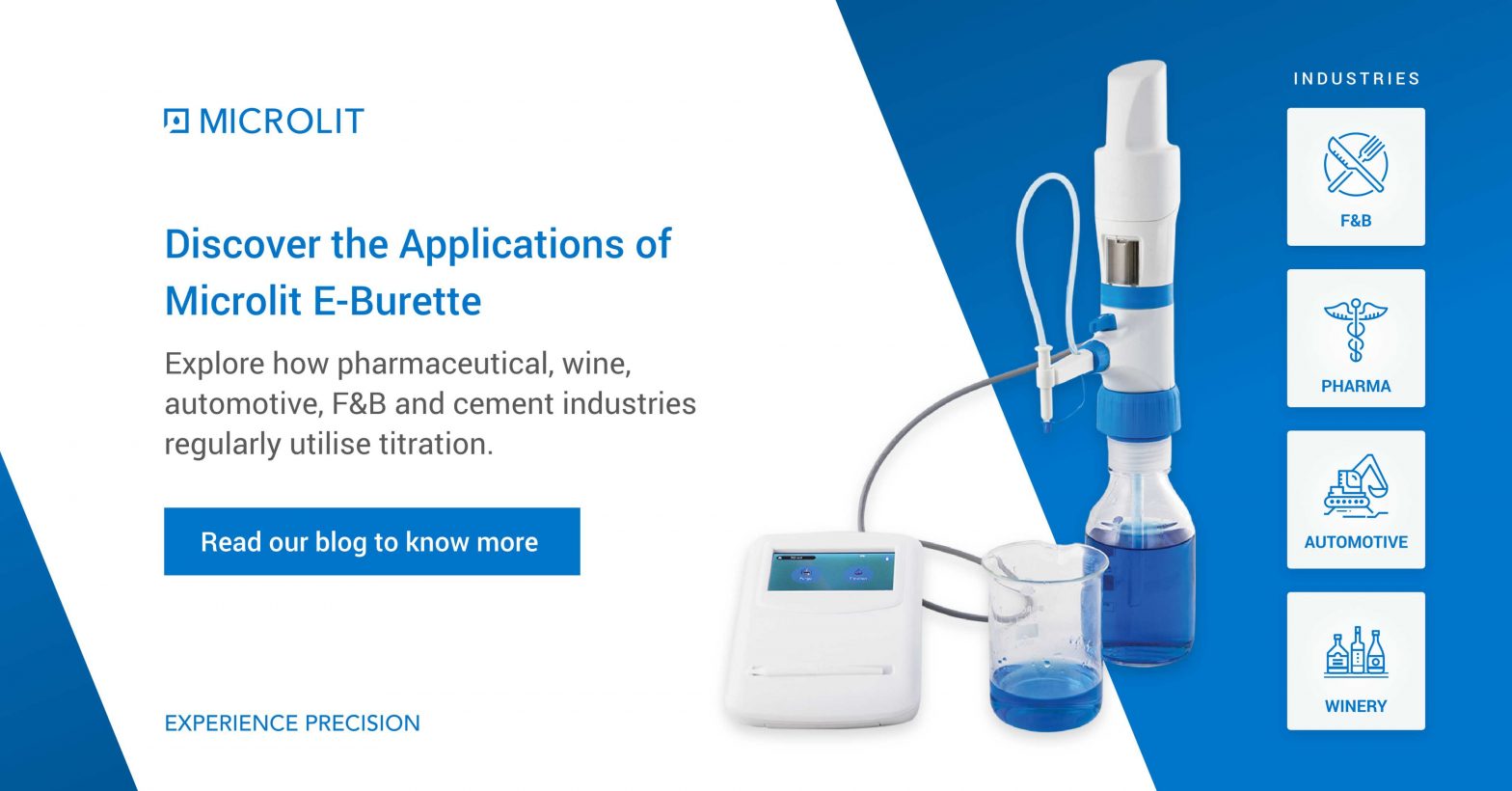
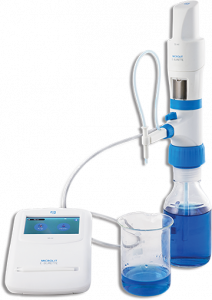
A piece of state-of-the-art lab equipment, the e-burette designed by the product engineers at Microlit offers sophisticated features and functionality like – motor controlled piston movement, touch screen enabled control panel with graphical user interface (GUI), one-touch filling operation and three calibrated preset speeds to perform highly accurate titrations.
Electronic Burette –Microlit

The e-burette is commonly used to carry out titrations. Titration is a quantitative chemical analysis where a solution of known concentration is used to determine the concentration of an unknown solution. The titrant (the known solution) is added to a known quantity of the analyte (the unknown solution) until the reaction is complete. 


The titration process is of four types –

  • Acid-base Titration

The acid-base titration enables the user to determine the strength of an acid or a base. For acid, the strength can be determined by using a standard solution of a base which is known as acidimetry. Whereas, for a base, the strength can be found out with the help of a standard solution of an acid known as alkalimetry.

  • Redox Titration

Also known as an oxidation-reduction reaction, redox titration is a chemical reaction that takes place with a transfer of electrons in the reacting ions of aqueous solutions. The titrations are named after the reagent used, and are as follows:

  1. Permanganate Titrations
  2. Dichromate Titrations
  3. Iodimetric and Iodometric Titration
  • Precipitation Titration

The precipitation titration is based on the precipitate formation when two reacting substances are brought in contact with each other.

  • Complexometric Titration

A titration where an undissociated complex is formed at an equivalence point is known as complexmetric titration. This titration process is free from errors due to co-precipitations and is greater than precipitation titrations.

The process of titration is widely used in various industries. Listed below are its various industrial applications.

Pharmaceutical Industry

The pharmaceutical industry is the enabler of discovering, developing, producing, and marketing drugs to be used as a medication for patients, with the sole aim of curing or vaccinating them, or alleviating the symptoms. 

For the development of medications, a particular quantity of chemicals is to be determined. This measurement of the quantity of the chemicals is finalised by the process of titration. There are various titration procedures used in the pharmaceutical industry.


  • Purity analysis often uses acid-base titration.
  • Content analysis is done through redox titration to establish the purity of the raw material.
  • Precipitation titrations facilitate the formation of a solid product.
  • pH-stat titration is used to determine the acidity of the drugs, check the purity of enzymes and investigate the speed and other characteristics of the chemical reactions.

Wine Industry

The wine industry, ignored or banned in certain countries, is a significant business sector. The industry is large and is growing consistently. Quality and chemical precision are paramount in the wine industry and titration is used to determine the acidity and evaluate the content of sulfur dioxide.

Vintners (winegrowers) use titration throughout the winemaking process. It allows them to check the quality of raw materials used for production and bring out the flavour of the wine. Titration also helps to check the batch while fermentation is taking place, and the same is used for final quality control.

Automotive Industry

One of the largest industries by revenue, the automotive industry comprises various organizations that are involved in the design, development, manufacturing, marketing, and selling of vehicles. The automotive industry uses the titration process for the production of biodiesel oil.

The biodiesel oil is required to have a particular pH level to ensure its functionality. For this purpose, titration comes in handy. Manufacturers measure the pH level of biodiesel and then determine the amount of base to be used to achieve the desired pH level. During this process, the concentration of biodiesel, the concentration of base and the exact volume of the fuel are known, determining the correct volume of the base required to make the fuel easy. 

Food & Beverage Industry

The F&B industry comprises all the companies that are involved in the processing of raw materials, packaging and distribution. This includes fresh, prepared food as well as packaged food, and alcoholic and non-alcoholic beverages. The industry uses the technique of titration for mainly two purposes – regulatory requirements and quality control.

It has been mandated by respective regulatory bodies that all food labels should state the content of sodium, calcium and iron. Hence, every manufacturer must test and measure the quantities of these minerals. The presence of these minerals is determined by precipitation and complexometric titration.

The manufacturers use acid-base titration for quality control. It is important to regulate the taste, texture, nutrition, stability and appearance of food. Acidity in food is a major deciding factor of the bitterness of a food item or a beverage. By performing an acid-base titration, manufacturers can determine the amount of acid in their product and regulate the flavour of the product. This also enables the manufacturers to ensure that the taste of the product is similar across all batches.

Cosmetic Industry

The cosmetic industry has witnessed an explosive boom in recent times, especially among the young, independent brands. The industry manufactures and distributes cosmetic products including, colour cosmetics and toiletries.

There are always certain chemicals used for the production of cosmetics. But, the manufacturers need to add appropriate concentration and amount of chemicals to ensure that it does not cause any harm to the user. This is where titration is used. The process of titration also enables the manufacturers to determine the best suitable base for cosmetics, for instance, coconut oil is used as a base in many products.  

Visit Burette page to know more about the Microlit E-Burette.

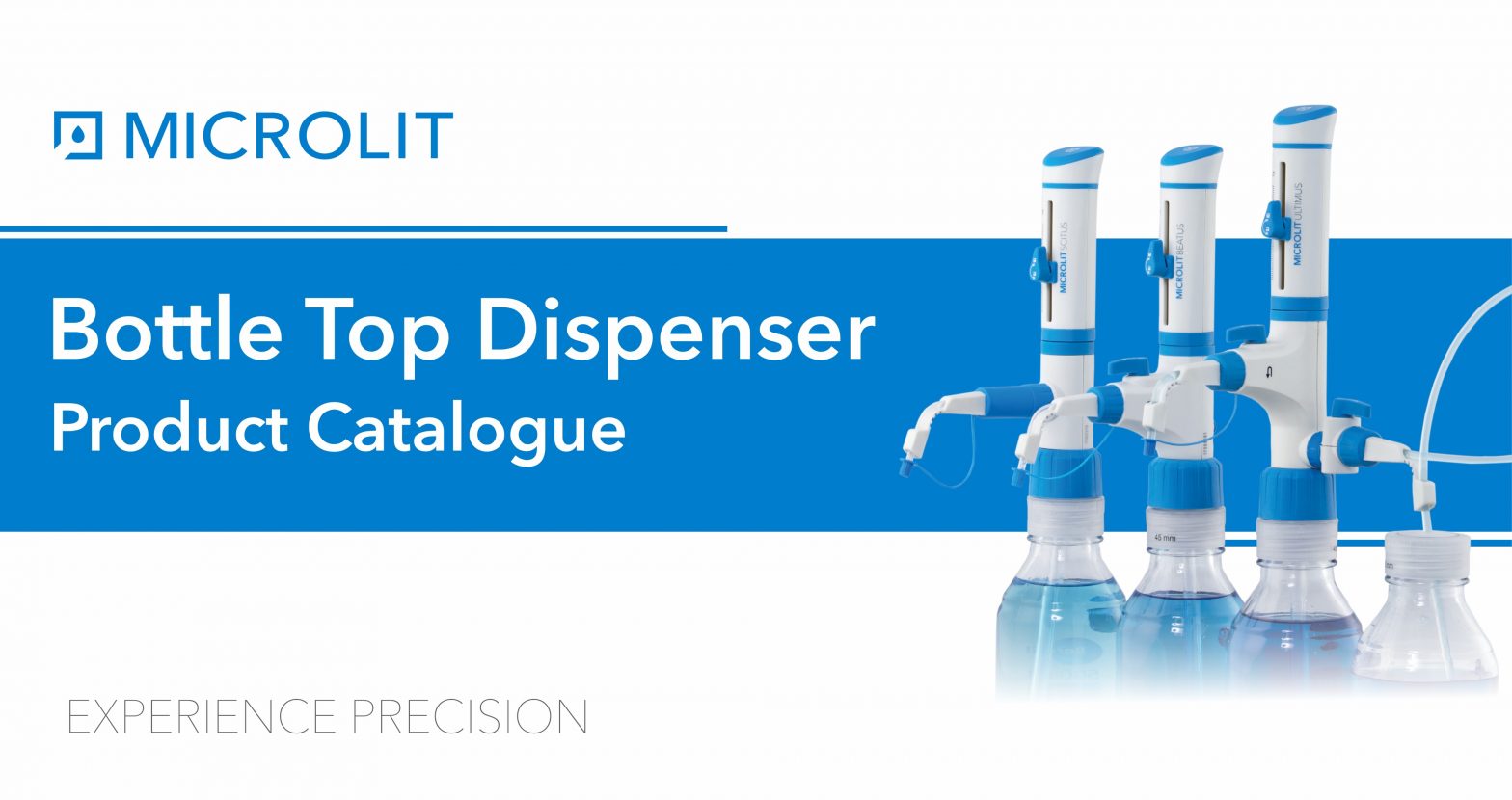
Bottle Top Dispenser Product Catalogue

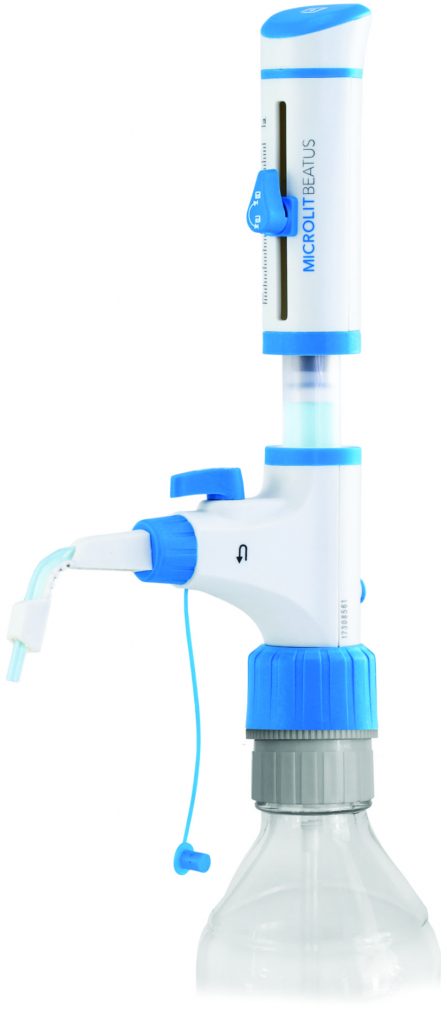
Microlit Beatus

The instrument is fully autoclavable at 121 °C and 15 psi for a duration of 10 – 15 minutes.

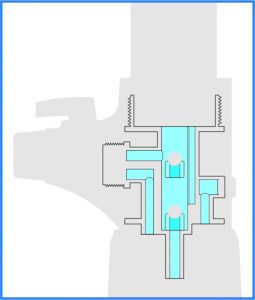
Springless Valve™ Technology : Get Smooth and Service-free Operation with Springless Valve™ Technology

Bottle Top Dispenser - beatus

Traditional Bottle Top Dispensers contain two valves with glass balls:

Inlet Valve:
This valve is vertical. It operates under gravity and does not require a spring to hold the glass ball in its position, in order to keep the valve closed.
Outlet Valve:
This valve is horizontal. It requires a spring to keep the glass ball in its position, in order to keep the valve closed while aspirating reagents in the barrel. It opens only when a reagent is being dispensed.

The spring, housed in the Outlet Valve, poses a lot of problems:

  • The user has to procure different kinds of Bottle Top Dispensers for different applications owing to spring metal reactivity. This proves to be an expensive proposition.
  • Apart from this, the spring also offers a surface for deposition of chemicals. This results in a piston jam, thereby compelling the user to repeatedly clean the valve, or replace it altogether.

Our product design engineers have expertly addressed these problems by designing a system where both Inlet and Outlet Valves are vertical and hence do not require any spring. This Springless Valve™ Technology makes MICROLIT BEATUS a Universal Bottle Top Dispenser that can be conveniently used with both organic and inorganic reagents. It not only offers smooth, jam-free piston movement but also ensures service-free operation.

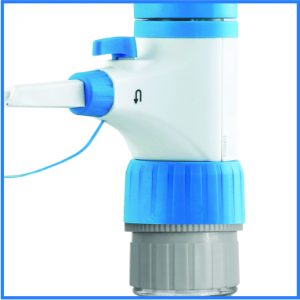
Re-direct Liquids with Recirculation Valve

Recirculation Valve prevents the loss of reagents during purging by re-directing them into the mounted bottle and facilitates bubble free dispensing.

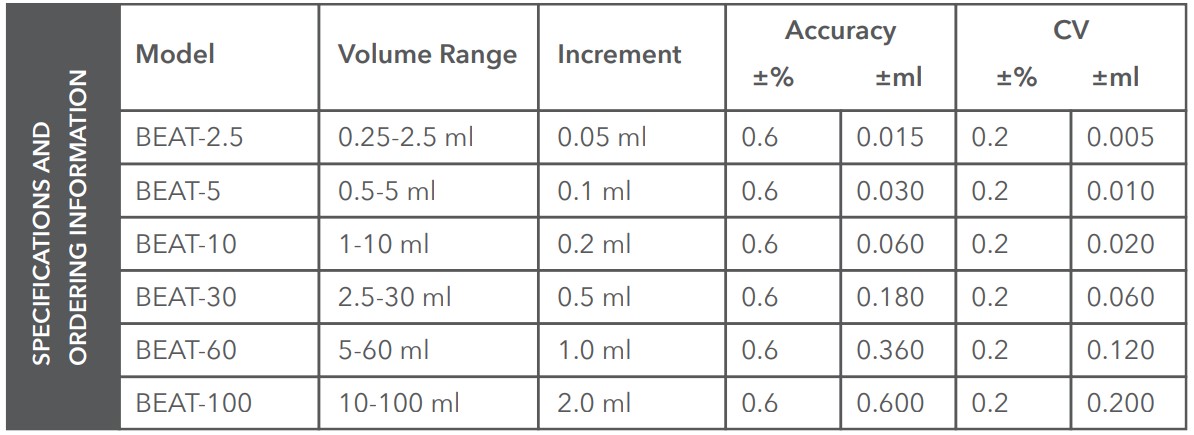
MICROLIT BEATUS is available in six unique volume ranges.

The error limits (Accuracy and Coefficient of Variation) mentioned above are in accordance with the nominal capacity (or maximum volume) indicated on the instrument. These are obtained by using the instrument with distilled water at equilibrium, the ambient temperature of 20 °C while operating it smoothly and steadily. The error limits are in accordance with DIN EN ISO 8655-5.


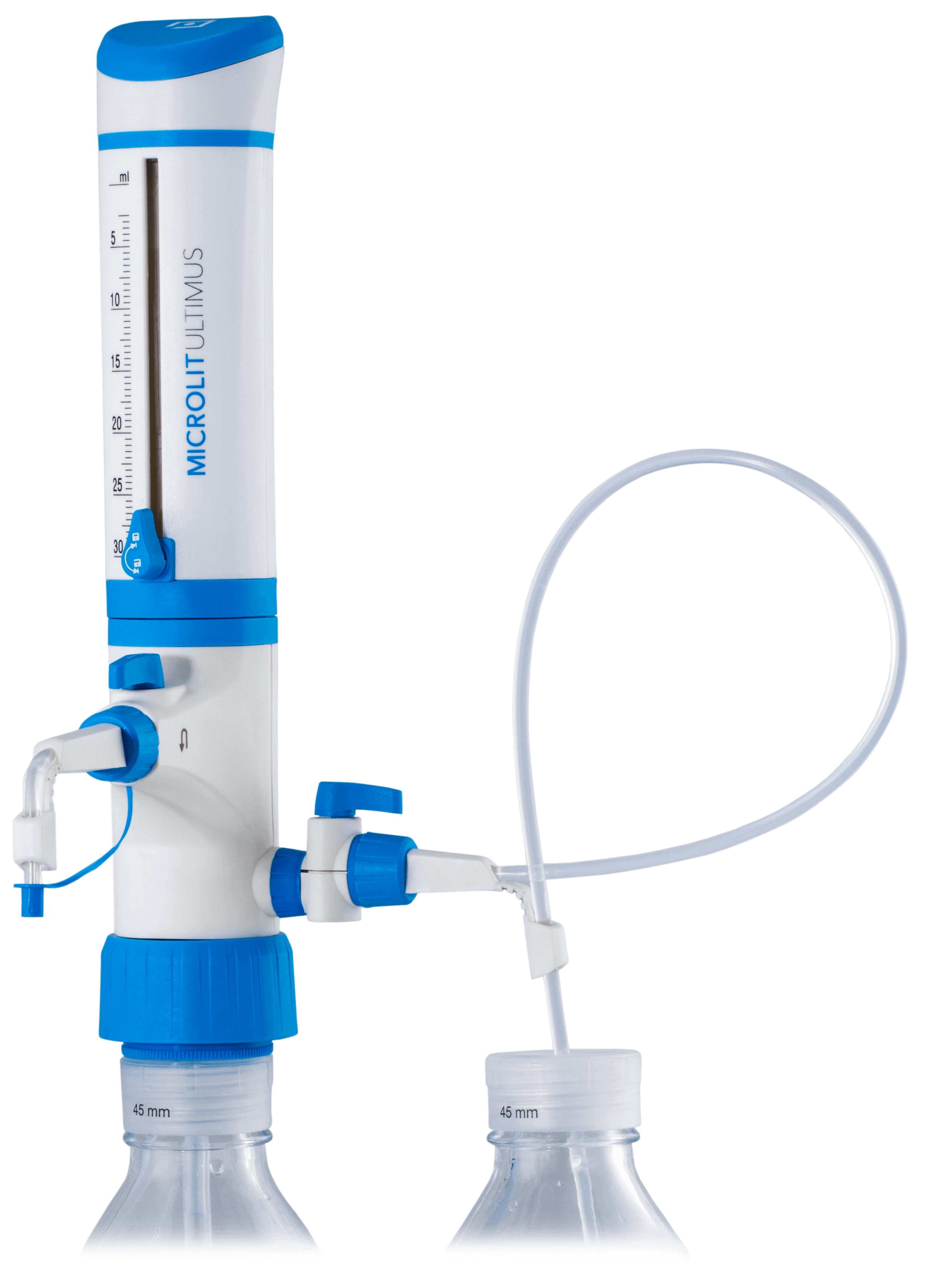
Microlit Ultimus

The instrument is fully autoclavable at 121 °C and 15 psi for a duration of 10 – 15 minutes.

Dual Inlet™ Technology : Enhance Your Productivity with Four Modes of Operation

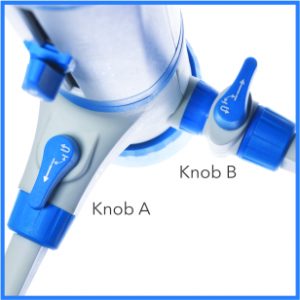
1.  Standard Dispensing
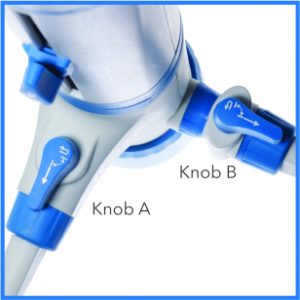
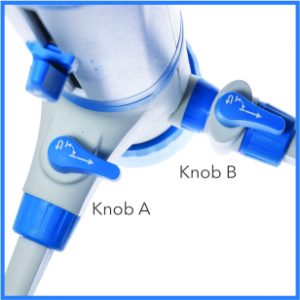
Knob A – Open    Knob B – Closed
In this mode, the dispenser dispenses the liquid normally into the receiver from the bottle it is mounted on.
2.  Purging
Knob A – Closed    Knob B – Closed
In this mode, the liquid is re-circulated into the same bottle on which the
dispenser is mounted. This process removes the air from the dispenser, without wasting any reagent.
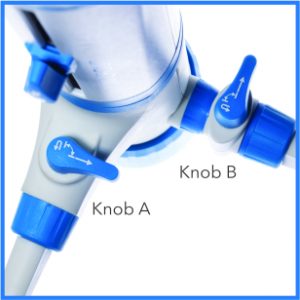
3.  Dilution/Rinsing/Second Liquid Dispensing
Knob A – Open    Knob B – Open
In this mode, the liquid from a second source can be dispensed into the receiver. The second liquid can be distilled water, thus allowing the user to rinse the instrument without dismounting it or dilute the reagent within the receiver.
4.  Bottle Refilling
Knob A – Closed    Knob B – Open
In this mode, the liquid from a second source can be used to refill the bottle, without dismounting the dispenser.

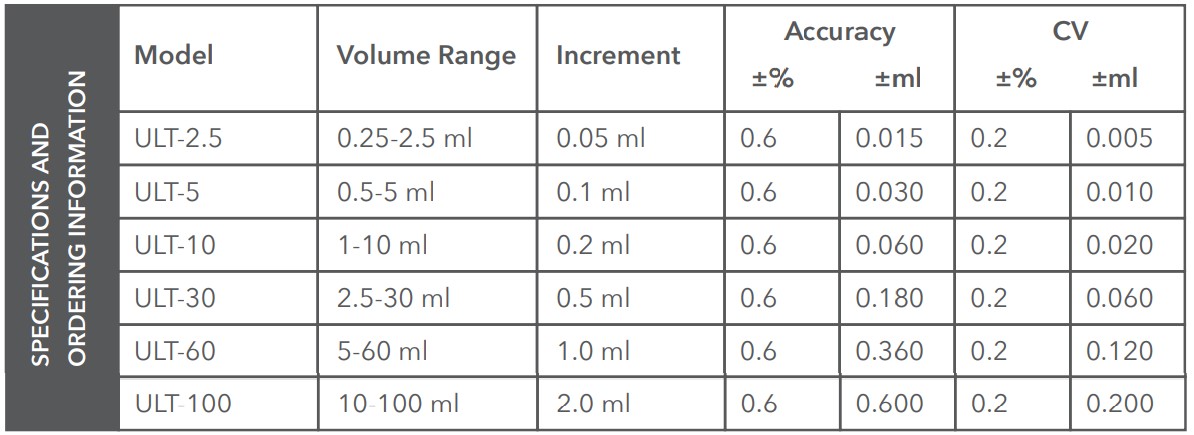
MICROLIT ULTIMUS is available in six unique volume ranges.

The error limits (Accuracy and Coefficient of Variation) mentioned above are in accordance with the nominal capacity (or maximum volume) indicated on the instrument. These are obtained by using the instrument with distilled water at equilibrium, the ambient temperature of 20 °C while operating it smoothly and steadily. The error limits are in accordance with DIN EN ISO 8655-5.


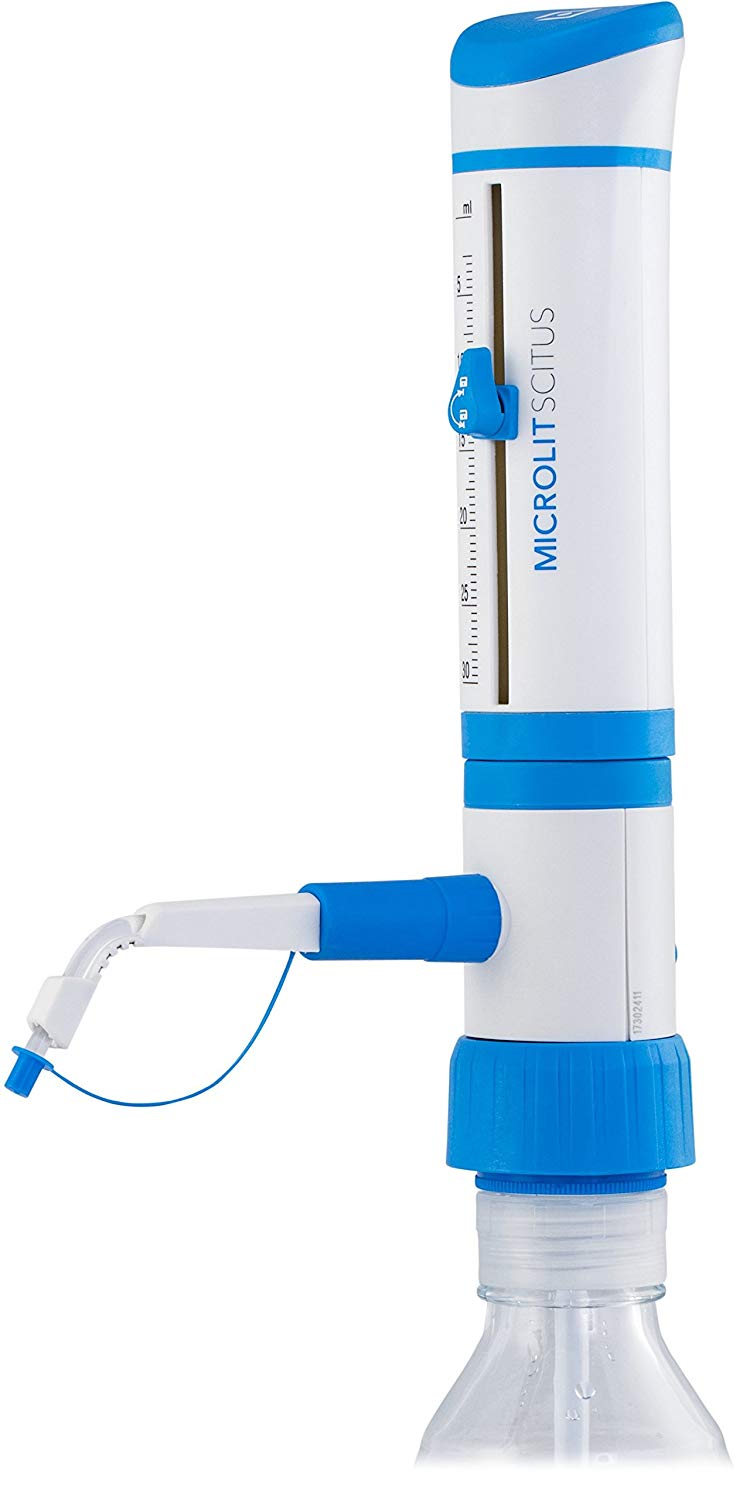
Microlit Scitus

The instrument is fully autoclavable at 121 °C and 15 psi for a duration of 10 – 15 minutes.

Springless Valve™ Technology : Operate Jam-free and Work without Hassles with Springless Valve™ Technology

Traditional Bottle Top Dispensers contain two valves with glass balls:

Inlet Valve:
This valve is vertical. It operates under gravity and does not require a spring to hold the glass ball in its position, in order to keep the valve closed.

Outlet Valve:
This valve is horizontal. It requires a spring to keep the glass ball in its position, in order to keep the valve closed while aspirating reagents in the barrel. It opens only when a reagent is being dispensed.


The spring, housed in the Outlet Valve, poses a lot of problems:

  • The user has to procure different kinds of Bottle Top Dispensers for different applications owing to spring metal reactivity. This proves to be an expensive proposition.
  • Apart from this, the spring also offers a surface for deposition of chemicals. This results in a piston
    jam, thereby compelling the user to repeatedly clean the valve, or replace it altogether.

Our product design engineers have expertly addressed these problems by designing a system where both Inlet and Outlet Valves are vertical and hence do not require any spring.
This Springless Valve™ Technology makes MICROLIT SCITUS a Universal Bottle Top Dispenser that can be conveniently used with both organic and inorganic reagents.
It not only offers smooth, jam-free piston movement but also ensures service-free operation.

MICROLIT SCITUS is available in six unique volume ranges.

The error limits (Accuracy and Coefficient of Variation) mentioned above are in accordance with the nominal capacity (or maximum volume) indicated on the instrument. These are obtained by using the instrument with distilled water at equilibrium, the ambient temperature of 20 °C while operating it smoothly and steadily. The error limits are in accordance with DIN EN ISO 8655-5.

The precision and accuracy of our liquid handling instruments is twice better than industry standards.*
*ISO 8655 is the globally accepted industry standard for piston-operated volumetric apparatus. The evaluation was performed by trained and certified personnel at an ISO17025 accredited lab.